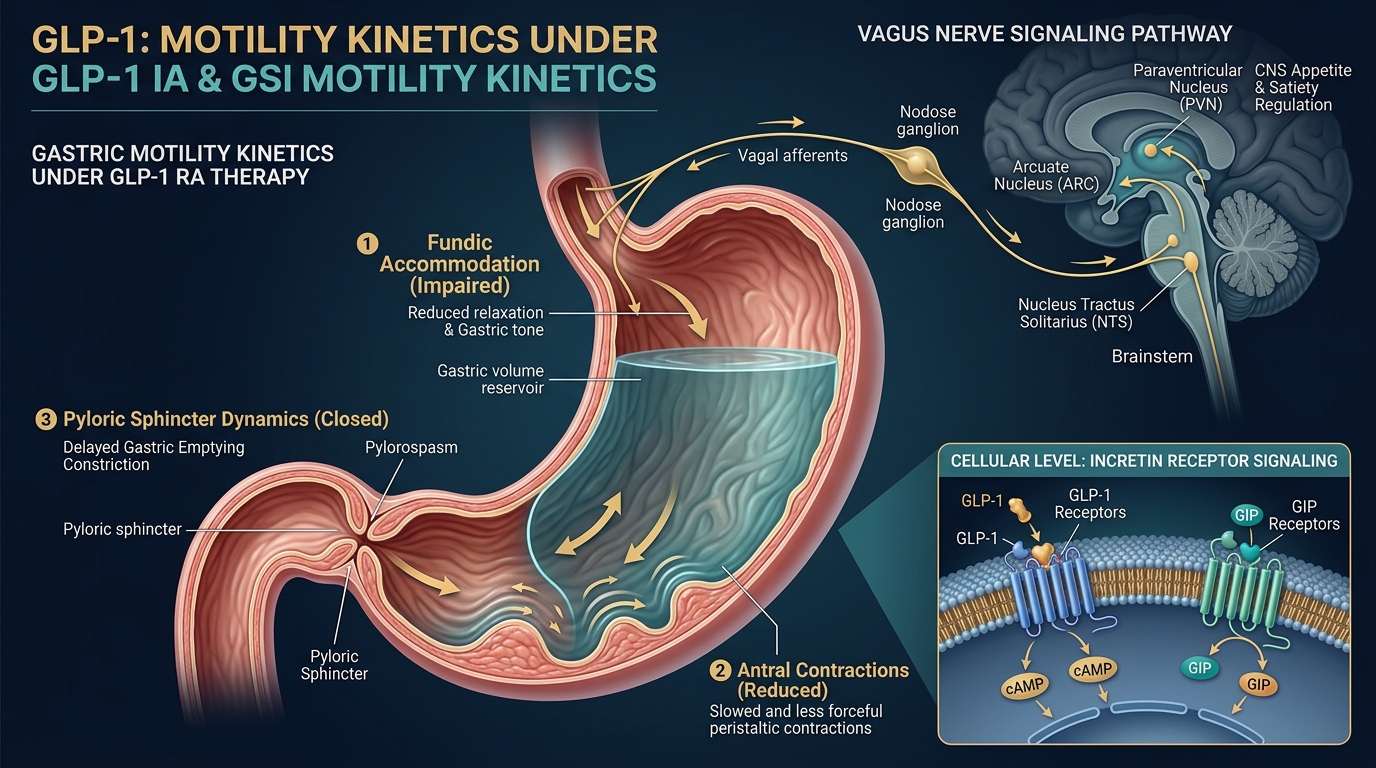
1. Incretin Motor Physiology: How GLP-1 & GIP Alter Upper GI Kinetics
Over the past four years, the cultural narrative surrounding glucagon-like peptide-1 receptor agonists (GLP-1 RAs) such as semaglutide (Ozempic, Wegovy) and dual glucose-dependent insulinotropic polypeptide / GLP-1 receptor agonists like tirzepatide (Mounjaro, Zepbound) has shifted from specialized endocrinology into global entertainment headlines. In Hollywood and pop culture, these compounds are frequently characterized as miraculous "appetite erasers."
Yet as gastroenterologists, we evaluate these agents not through the lens of aesthetic weight loss, but through the fundamental lens of gastrointestinal neuromuscular motor kinetics. The profound reduction in caloric intake produced by incretin therapies is not simply a psychiatric phenomenon of willpower; it is intimately coupled to a dramatic, pharmacological reprogramming of upper digestive motility.
The Entero-Endocrine Axis & the Ileal Brake
Under normal human physiology, native GLP-1 is synthesized and secreted by enteroendocrine L-cells residing predominantly in the distal ileum and colon in response to luminal nutrients—especially unabsorbed fatty acids and carbohydrates. Once secreted, native GLP-1 exhibits an extraordinarily brief plasma half-life of less than two minutes, rapidly inactivated by the ubiquitous enzyme dipeptidyl peptidase-4 (DPP-4).
Native GLP-1 functions as the primary mediator of the "ileal brake"—an evolutionary physiological feedback mechanism designed to prevent nutrient dumping. When unabsorbed calories reach the distal intestine, GLP-1 signals proximal segments of the gut to slow gastric emptying and duodenal transit, ensuring maximal nutrient digestion and absorption upstream.
Synthetic pharmacological agonists like semaglutide and tirzepatide are chemically modified—possessing fatty diacid chains that facilitate non-covalent albumin binding and amino acid substitutions (such as alpha-aminoisobutyric acid at position 8) that render them completely resistant to DPP-4 degradation. Consequently, these drugs produce continuous, supraphysiological incretin receptor occupancy for a full seven days following a single subcutaneous injection.
Mechanisms of Delayed Gastric Emptying
How does prolonged incretin signaling arrest gastric transit? The physiological sequence operates across three coordinated gastric compartments:
- Impaired Proximal Fundic Accommodation: Normally, ingestion of a meal triggers vagally mediated receptive relaxation of the gastric fundus, allowing the stomach to expand into a low-pressure reservoir capable of holding up to 1.5 liters without triggering discomfort. GLP-1 RAs increase proximal gastric wall tone and blunt receptive relaxation, generating increased intragastric pressure upon food entry.
- Antral Hypomotility: The distal stomach (antrum) functions as a muscular grinder, generating powerful 3-cycle-per-minute peristaltic contractions that crush solid food particles against a closed pylorus into chyme smaller than 1 to 2 millimeters. GLP-1 receptor activation significantly suppresses the frequency and amplitude of antral phasic contractions.
- Pylorospasm & Pyloric Resistance: Incretin agonists induce sustained tonic contraction of the pyloric sphincter, raising the outflow resistance that chyme must overcome to enter the duodenal bulb.
Vagal Afferent Signaling & the Brainstem Connection
This mechanical slowing is not solely an intrinsic muscular effect; it is centrally coordinated via the autonomic nervous system. GLP-1 receptors are densely expressed on nodose ganglion vagal sensory afferent fibers innervating the gastric mucosa and muscularis.
Vagal afferents transmit mechanical stretch and incretin signals directly to the nucleus tractus solitarius (NTS) in the dorsal vagal complex of the caudal brainstem. From the NTS, ascending projections synapse within the area postrema, the parabrachial nucleus, and the arcuate and paraventricular nuclei of the hypothalamus. This neural cascade stimulates proopiomelanocortin (POMC) neurons and suppresses orexigenic neuropeptide Y (NPY) and agouti-related peptide (AgRP) neurons, translating prolonged gastric distension into powerful central satiation, early satiety, and abolition of food-seeking behavior ("food noise").
Tachyphylaxis vs Persistent Motor Delay
A critical pharmacodynamic concept is tachyphylaxis—the gradual attenuation of a drug's biological effect over repeated exposure. Rigorous clinical pharmacology investigations, such as the scintigraphic trial by Urva et al. (Diabetes, Obesity and Metabolism, PMID: 32519795), demonstrated that while dual GIP/GLP-1 agonists like tirzepatide induce substantial gastric emptying delay following acute initial administration, the magnitude of this delay attenuates substantially after consecutive weeks of steady-state dosing.
However, "attenuation" is not synonymous with complete normalization. In many clinical patients, particularly at higher maintenance dosages (semaglutide 2.4 mg or tirzepatide 15 mg), a clinically relevant degree of solid food retention persists throughout the duration of therapy.
2. The Clinical Dilemma: Expected Satiety vs True Drug-Induced Gastroparesis
In media reporting and online patient communities, sensational claims frequently emerge asserting that GLP-1 medications "permanently paralyze the stomach," leading to widespread fear of irreversible gastroparesis.
In clinical gastroenterology, precision in terminology is vital. We must clearly distinguish between expected pharmacological gastric delay and pathological clinical gastroparesis:
| Clinical Feature | Expected Incretin Pharmacodynamics | Drug-Induced Gastroparesis Syndrome | Mechanical Bowel Obstruction / Ileus |
|---|---|---|---|
| Primary Symptoms | Early satiety, mild postprandial fullness, occasional transient nausea during dose escalation. | Intractable nausea, persistent vomiting of undigested food ingested 12+ hours prior, severe epigastric pain, weight loss beyond caloric goals. | Severe diffuse colicky abdominal pain, marked distension, absolute obstipation (no flatus or stool), bilious or feculent vomiting. |
| Endoscopy (EGD) Findings | Normal clear mucosa or minimal liquid residue after standard extended overnight fast. | Copious solid food retention or phytobezoar formation despite 12–16 hours of strict fasting; absent mucosal ulceration. | Dilated fluid-filled bowel, ischemic mucosal changes, mechanical point of transition on CT imaging. |
| 4-Hour Solid Scintigraphy (GES) | Mildly prolonged 1–2 hour retention, but 4-hour gastric retention typically ≤ 10–15% on chronic maintenance. | Markedly abnormal: > 10% retention at 4 hours (frequently > 25–35% retention of radiolabeled egg meal). | Contraindicated during acute suspected mechanical obstruction. |
| Course Upon Drug Cessation | Fullness resolves as drug half-life elapses (4–5 weeks for complete systemic clearance). | Symptoms and gastric emptying typically normalize over weeks to months following drug withdrawal. Irreversibility is exceedingly rare in the absence of preexisting diabetic neuropathy. | Requires emergent nasogastric decompression, surgical consult, or operative intervention. |
The Reality of Retained Food at Endoscopy
Endoscopists nationwide have reported an unprecedented surge in finding substantial volumes of retained solid food during routine screening colonoscopies and upper endoscopies (EGDs) in patients taking GLP-1 medications, despite the patient having observed standard 8- to 12-hour overnight fasting.
While finding a stomach full of undigested dinner is alarming, retained food on endoscopy is not by itself a definitive diagnosis of permanent gastroparesis. It reflects an objective acute delay in gastric clearance under the influence of active incretin receptor occupancy. In non-diabetic patients without preexisting autonomic neuropathy, comprehensive post-marketing pharmacovigilance data indicates that gastric motor function overwhelmingly recovers following discontinuation of the offending agent as the drug undergoes metabolic clearance over several half-lives.
3. Perioperative Aspiration Risk & ASA Anesthesia Guidelines
The most critical acute medical hazard associated with GLP-1-mediated gastric delay occurs not in outpatient dining rooms, but inside operating rooms and endoscopy surgical suites.
The Pathophysiology of Pulmonary Aspiration
Standard preoperative fasting guidelines (historically the American Society of Anesthesiologists 2-4-6-8 rule: 2 hours for clear liquids, 6 hours for light meals, 8 hours for fatty/fried foods) were established on the premise of normal, healthy gastric emptying kinetics. Under normal physiology, the stomach empties liquids within 60 to 90 minutes and solids within 4 hours.
When a patient on therapeutic doses of semaglutide or tirzepatide arrives for elective surgery, their stomach may still contain several hundred milliliters of acidic chyme and gastric secretions. During induction of general anesthesia—when protective laryngeal reflexes are abolished and neuromuscular blockade is administered—the loss of lower esophageal sphincter tone combined with positive-pressure mask ventilation can trigger passive regurgitation and massive pulmonary aspiration.
Aspiration of acidic gastric content (pH < 2.5) into the bronchial tree causes acute chemical burn of the alveolar-capillary membrane (Mendelson's syndrome), severe hypoxemic respiratory failure, acute respiratory distress syndrome (ARDS), and high mortality.
The 2023 ASA Consensus & Updated Multi-Society Protocols
In June 2023, the American Society of Anesthesiologists (ASA) issued an urgent consensus statement recommending:
- Holding daily GLP-1 agonists (e.g., oral semaglutide, subcutaneous liraglutide) on the morning of surgery.
- Holding once-weekly GLP-1 agonists (e.g., subcutaneous semaglutide, tirzepatide, dulaglutide) for a full 7 days prior to elective procedures requiring general anesthesia or deep sedation.
Subsequent joint gastroenterology and anesthesia guidance has evolved toward an individualized, risk-stratified protocol. Patients are assessed for active gastrointestinal symptoms (nausea, vomiting, severe fullness), current dosage, and titration status. In many modern endoscopy centers, anesthesiologists utilize point-of-care gastric ultrasound (POCUS) at the bedside immediately prior to sedation to directly visualize the gastric antrum in both supine and right-lateral decubitus positions. If a "full stomach" (solid chyme or high-volume clear fluid > 1.5 mL/kg) is visualized, elective procedures are postponed or managed with rapid sequence induction (RSI) and endotracheal intubation.
4. Lower GI Motility: Constipation, Colon Transit & Rare Ileus Complications
While gastric emptying delay captures headlines, GLP-1 receptors are distributed along the entire length of the gastrointestinal tract, including the small intestine and myenteric plexus of the colon.
The Pathogenesis of GLP-1-Induced Constipation
Constipation is among the most frequent clinical complaints reported in clinical trials, affecting up to 25% of semaglutide and 17% of tirzepatide recipients. The clinical pathogenesis involves a multifactorial confluence of mechanics:
- Suppression of the Gastrocolic Reflex: Ingestion of food normally triggers a coordinated neuro-hormonal reflex mediated by gastric distension, stimulating mass peristaltic movements in the colon to evacuate stool. Because GLP-1 blunts rapid gastric filling and alters vagal efferents, the gastrocolic reflex is substantially diminished.
- Prolonged Colonic Transit Time: As colonic peristalsis slows, fecal matter remains in the ascending and transverse colon for extended durations. The colonic epithelium continues its physiological function of reabsorbing water and electrolytes, rendering the resulting stool dry, hard, and scybalous (pellet-like).
- Drastic Reduction in Dietary Mass and Hydration: Patients experiencing potent central appetite suppression frequently reduce their total daily fluid intake and drastically diminish their intake of dietary fiber and bulk mass, depriving the colonic lumen of the mechanical stretch required to stimulate propulsive peristalsis.
Red Flags: When Constipation Becomes Obstruction
In rare cases, severe constipation can progress to fecal impaction, stercoral ulceration, or paralytic ileus—a state of generalized intestinal hypomotility without mechanical blockage.
Patients must be educated to recognize clear clinical red flags that distinguish routine, manageable constipation from an acute surgical abdomen:
- Complete obstipation: Inability to pass flatus (gas) or stool for greater than 72 hours despite laxative therapy.
- Progressive abdominal distension: Visible, painful bloating with a tympanitic (drum-like) abdomen.
- Bilious or feculent emesis: Vomiting green-yellow bile or foul-smelling liquid.
- Continuous, localized, or severe cramping pain: Pain that worsens rather than improves after attempting a bowel movement.
For routine incretin-associated constipation, gastroenterologists recommend proactive osmotic hydration: daily polyethylene glycol (PEG 3350), 2.5 to 3 liters of water, and soluble fermentable fiber (such as partially hydrolyzed guar gum or psyllium, provided adequate hydration is maintained).
5. Body Composition & Skeletal Muscle Preservation: The Sarcopenia Threat
In entertainment circles, rapid physical transformations are celebrated. However, from a metabolic and longevity perspective, the quality of weight lost is infinitely more important than the numerical reading on the scale.
When patients undergo rapid, drastic caloric restriction induced by potent incretin therapy without structured dietary and physical countermeasures, they do not lose visceral adipose tissue exclusively. They lose substantial amounts of lean body mass (skeletal muscle).
DEXA Body Composition Data from Incretin Trials
Sub-analyses of the landmark STEP-1 clinical trial using dual-energy X-ray absorptiometry (DEXA) scans revealed that while participants achieved an average total weight loss of approximately 15%, approximately 25% to 40% of the total weight lost consisted of lean body mass.
While some reduction in lean mass naturally accompanies any substantial weight reduction (as less structural tissue is needed to support a smaller physical frame), disproportionate loss of skeletal muscle carries severe long-term consequences:
- Metabolic Rate Collapse: Skeletal muscle is the most metabolically active tissue in the resting human body. Every kilogram of lost muscle tissue reduces baseline resting metabolic rate (RMR), dramatically lowering the daily caloric threshold required to maintain weight.
- Impaired Glycemic Sink: Skeletal muscle accounts for greater than 80% of all insulin-mediated postprandial glucose disposal via GLUT4 translocation. Loss of muscle mass impairs peripheral insulin sensitivity, worsening long-term metabolic flexibility.
- Sarcopenic Obesity: If a patient loses 30 pounds (composed of 18 lbs fat and 12 lbs muscle) and subsequently discontinues the medication, the weight regained is almost exclusively 100% adipose tissue. The patient ends up at their original weight but with a significantly higher body fat percentage, lower muscle mass, and a severely compromised metabolic rate.
- Protein Prioritization: Target 1.2 to 1.6 grams of complete protein per kilogram of ideal body weight daily, distributed across 3–4 feeding windows to stimulate muscle protein synthesis (MPS).
- Mandatory Progressive Resistance Training (PRT): Engage in progressive resistance exercise at least 3 days per week to provide the mechanical tension required to signal mTOR and prevent muscle catabolism.
- Avoid Starvation-Level Caloric Deficits: Maintain a moderate caloric deficit (no greater than 500–750 kcal/day below total daily energy expenditure) rather than tolerating near-complete fasting.
6. What Happens When You Stop: The STEP-1 Trial Extension & Rebound Biology
Perhaps the most crucial clinical conversation in modern metabolic gastroenterology centers on the question: "What happens when I reach my goal weight and stop the injections?"
In Hollywood culture, GLP-1 agonists are often treated as temporary sprint medications—used for 3 to 6 months to prepare for a wedding, concert tour, or red-carpet movie premiere, after which the patient abruptly ceases therapy expecting to maintain their newly acquired physique through basic lifestyle discipline.
The peer-reviewed clinical science paints an entirely different, uncompromising picture.
The Landmark STEP-1 Trial Extension Data
In a pivotal study published by Wilding and colleagues in Diabetes, Obesity and Metabolism (2022;24:1553–1564; PMID: 35441470), investigators evaluated what occurred when participants who had received semaglutide 2.4 mg once weekly for 68 weeks were randomized to withdraw the medication and formal lifestyle interventions for one year (52 weeks of post-treatment observation):
- Regain of Lost Weight: Within 52 weeks of stopping semaglutide, participants regained an average of 11.6 percentage points of body weight—representing approximately two-thirds (66%) of all weight previously lost during the 68 weeks of active treatment.
- Rebound of Cardiometabolic Biomarkers: Blood pressure, fasting blood glucose, HbA1c, fasting insulin (HOMA-IR), and lipid profiles (total cholesterol, triglycerides, and VLDL) all exhibited steep trajectories reversing back toward pre-treatment baseline levels.
- Cessation of Gastric Delay: As plasma concentrations of semaglutide cleared (taking approximately 5 to 7 weeks given the drug's 168-hour half-life), upper gastrointestinal motor kinetics completely normalized, restoring rapid gastric emptying and baseline antral grinding mechanics.
The Neuro-Endocrine Homeostatic Trap
Why does weight regain occur so rapidly following GLP-1 cessation? It is not a failure of moral character; it is a profound neuro-endocrine survival mechanism.
The human body evolved in environments of chronic caloric scarcity. The hypothalamic energy-regulation circuitry treats significant weight loss as a life-threatening famine. When an incretin agonist is abruptly removed:
- Circulating Leptin Plummets: With the loss of substantial adipose tissue, circulating levels of leptin (the primary satiety hormone secreted by adipocytes) remain severely suppressed, depriving the hypothalamus of tonic satiety feedback.
- Orexigenic Ghrelin Surges: Gastric endocrine cells upregulate synthesis and secretion of ghrelin—the primary hunger hormone. With gastric emptying restored to rapid baseline speeds, the stomach clears rapidly, stimulating recurrent, intense ghrelin pulsatility.
- Resurgence of Central "Food Noise": The inhibitory suppression exerted on hypothalamic NPY/AgRP neurons evaporates. Patients report an overwhelming, visceral return of food preoccupation, heightened reward salience toward hyper-palatable foods, and severe hyperphagia.
Clinical Perspective: Chronic Disease Management vs Temporary Fix
The central conclusion of modern gastroenterology and obesity medicine is unequivocal: obesity and metabolic dysregulation are chronic, relapsing neuro-metabolic diseases, not acute temporary afflictions.
Just as a hypertensive patient does not discontinue their ACE inhibitor once their blood pressure reaches 120/80 mmHg, patients embarking on incretin therapy must understand that these medications are designed for long-term maintenance. If cessation is medically indicated or financially necessary, it must never be done abruptly. Patients should work with their physician on a structured, gradual dose-tapering schedule, coupled with aggressive resistance training, high-protein nutrition, and behavioral support to mitigate the physiological rebound.
7. Frequently Asked Questions (Clinical FAQ)
How do GLP-1 and dual GIP/GLP-1 medications slow gastric motility?
GLP-1 receptor agonists (such as semaglutide) and dual GIP/GLP-1 agonists (such as tirzepatide) slow upper gastrointestinal motility by activating receptors on nodose ganglion vagal sensory afferents. This triggers central inhibitory feedback through the brainstem nucleus tractus solitarius (NTS), reducing antral grinding contractions, impairing proximal fundic relaxation, and increasing pyloric tone, which significantly delays the clearance of solid food from the stomach into the duodenum.
Does experiencing nausea and prolonged fullness mean I have developed gastroparesis?
Not necessarily. Early fullness and mild, transient nausea are expected pharmacodynamic effects of delayed gastric emptying, particularly during initial dose escalation. Clinical gastroparesis is a distinct medical condition requiring intractable nausea, recurrent vomiting of undigested food hours after eating, persistent abdominal pain, and objectively confirmed delayed gastric emptying on a standardized 4-hour scintigraphy study after ruling out mechanical gastric outlet obstruction.
Does discovering retained food during an endoscopy prove drug-induced gastroparesis?
No. Retained food noted at upper endoscopy (EGD) indicates delayed gastric clearance, but it is not diagnostic of gastroparesis on its own. Fasting duration, acute illness, diabetic autonomic neuropathy, concomitant anticholinergic or opioid medications, and recent dose titration all influence gastric volume. A definitive diagnosis requires comprehensive clinical correlation and follow-up evaluation.
Why do anesthesiologists require special precautions for patients taking GLP-1 agonists before surgery?
Because GLP-1 receptor agonists delay gastric emptying, patients may retain significant solid or liquid gastric volume even after standard 8-hour preoperative fasting. During the induction of general anesthesia, retained gastric contents pose a severe risk of pulmonary aspiration, which can cause chemical pneumonitis, respiratory failure, or intensive care admission. Multi-society guidelines recommend risk stratification, point-of-care gastric ultrasound, and coordinated medication withholding.
What happens metabolically and physically when someone stops taking a GLP-1 receptor agonist?
In the landmark STEP-1 trial 1-year extension study (Wilding et al., 2022), patients who ceased semaglutide 2.4 mg regained approximately two-thirds (11.6 percentage points) of their lost weight within 52 weeks. As the medication clears, gastric motility normalizes, central appetite suppression lifts, orexigenic hormones like ghrelin rise, and prior cardiometabolic risk trajectories (blood pressure, fasting glucose, lipids) begin trending back toward pre-treatment baselines.
Can GLP-1 receptor agonists cause severe constipation or bowel obstruction?
Yes. Slower gastrointestinal transit allows increased mucosal water reabsorption in the colon, which, combined with reduced overall dietary volume and fluid intake, frequently causes constipation. In rare instances, severe colonic hypomotility can progress to obstipation, fecal impaction, or paralytic ileus. Inability to pass flatus or stool accompanied by severe abdominal distension and persistent vomiting requires immediate emergency gastroenterological evaluation.
8. Peer-Reviewed Clinical Literature & Citations
- Wilding JPH, et al. Weight regain and cardiometabolic effects after withdrawal of semaglutide: The STEP 1 trial extension. Diabetes Obes Metab. 2022;24(8):1553-1564. PMID: 35441470
- Urva S, et al. The novel dual GIP and GLP-1 receptor agonist tirzepatide transiently delays gastric emptying similarly to selective long-acting GLP-1 receptor agonists. Diabetes Obes Metab. 2020;22(10):1886-1891. PMID: 32519795
- Joshi GP, et al. (American Society of Anesthesiologists). American Society of Anesthesiologists consensus-based guidance on preoperative management of patients on glucagon-like peptide-1 (GLP-1) receptor agonists. ASA Practice Guidelines. 2023. PMID: 37982170
- Imeryüz N, et al. Glucagon-like peptide-1 inhibits gastric emptying via vagal afferent-mediated central mechanisms. Am J Physiol Gastrointest Liver Physiol. 1997;273(4):G920-G927. PMID: 9357836
- Camilleri M, et al. Gastric emptying of solids and liquids in humans: Physiological mechanisms and clinical evaluation. Neurogastroenterol Motil. 2020;32(11):e13997.
- Garber AJ, et al. Incretin-based therapies for type 2 diabetes and obesity: Mechanisms of action, clinical efficacy, and safety profile. Lancet Diabetes Endocrinol. 2021;9(6):389-402.