Resmetirom (Rezdiffra): Patient Eligibility, Mechanism, & Clinical Protocols for NASH Fibrosis
An evidence-based gastroenterological analysis of the first FDA-approved medication for metabolic dysfunction-associated steatohepatitis (MASH). Exploring THR-β receptor pharmacology, MAESTRO-NASH phase 3 trial endpoints, non-invasive F2–F3 qualification pathways, and real-world safety considerations.
Key Clinical Practice Takeaways
- Regulatory Milestone: On March 14, 2024, the FDA granted accelerated approval to resmetirom (Rezdiffra) for adults with noncirrhotic NASH/MASH exhibiting moderate to advanced liver fibrosis (consistent with stages F2 and F3).
- Dual Histologic Endpoints: In the landmark Phase 3 MAESTRO-NASH trial (Harrison et al., N Engl J Med 2024; PMID: 38324483), resmetirom achieved both MASH resolution without worsening of fibrosis (up to 29.9% vs. 9.7% placebo) and fibrosis improvement ≥1 stage without worsening of MASH (up to 25.9% vs. 14.2% placebo).
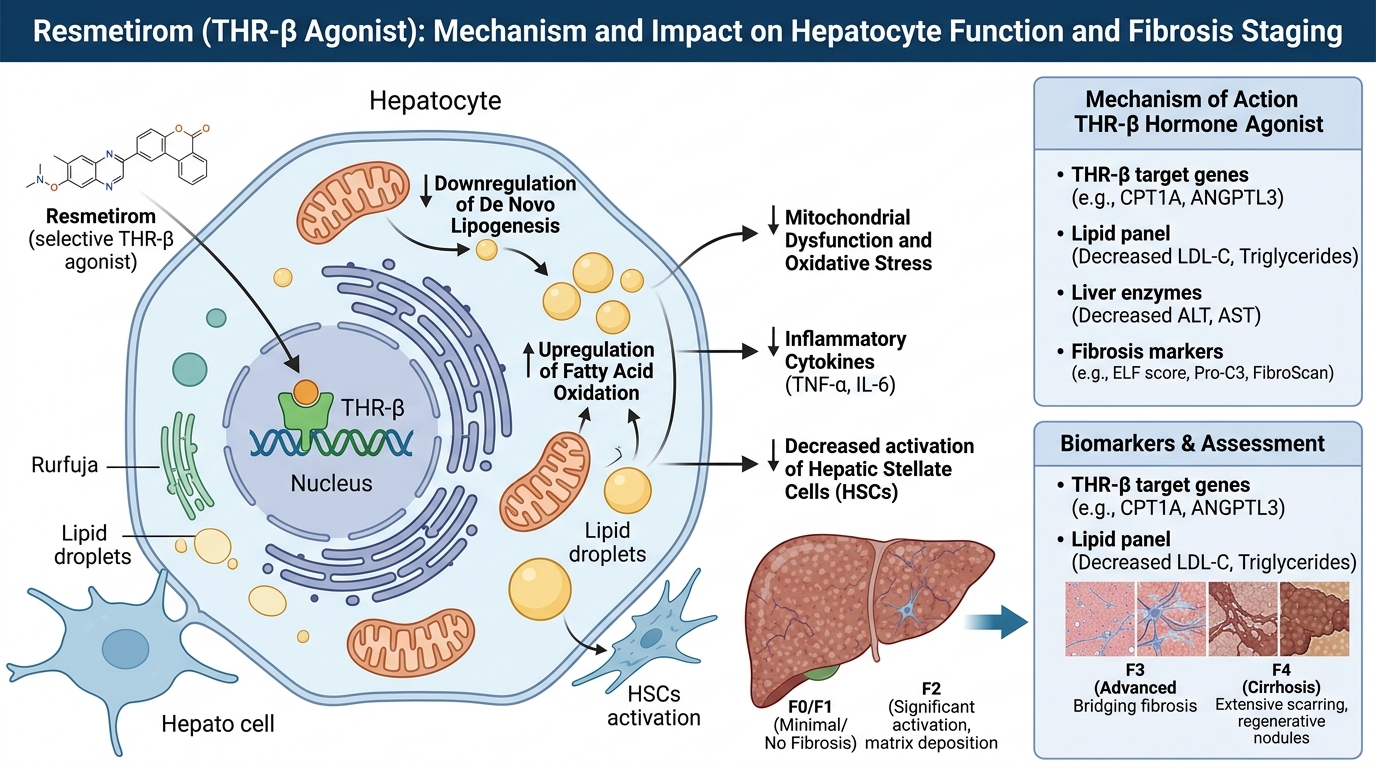
- Targeted Pharmacology: By selectively activating hepatic thyroid hormone receptor-beta (THR-β), resmetirom boosts mitochondrial β-oxidation of fatty acids and reduces lipotoxic metabolites without triggering the cardiac or bone toxicity mediated by THR-α.
- Biomarker-Driven Qualification: Clinical qualification avoids mandatory invasive biopsy by utilizing sequential non-invasive testing (NIT): baseline serologic testing with FIB-4 followed by vibration-controlled transient elastography (VCTE FibroScan) or magnetic resonance elastography (MRE).
1. A Watershed Moment in Hepatology: The FDA Approval of Rezdiffra
For over four decades, gastroenterologists and hepatologists faced a frustrating therapeutic void when counseling patients diagnosed with nonalcoholic steatohepatitis (now designated metabolic dysfunction-associated steatohepatitis, or MASH under the multi-society consensus nomenclature; Rinella et al., Hepatology 2023). While patients were consistently urged to adopt rigorous nutritional restrictions and aerobic exercise routines, there were zero targeted pharmacologic therapies approved by the United States Food and Drug Administration (FDA) to halt or reverse the progressive accumulation of extracellular matrix proteins that define hepatic fibrosis.
This clinical landscape underwent a fundamental paradigm shift on March 14, 2024, when the FDA granted accelerated approval to resmetirom (marketed under the trade name Rezdiffra, developed by Madrigal Pharmaceuticals). Resmetirom is officially indicated for the treatment of adults with noncirrhotic NASH/MASH who demonstrate moderate to advanced liver fibrosis (corresponding to histologic stages F2 and F3), to be utilized in conjunction with structured diet and physical activity.
As an educational health advisory, our goal is to dissect the biochemical mechanism, evaluate the clinical trial efficacy data, define exactly which patients qualify under current professional society guidelines, and explain how non-invasive diagnostic tools establish eligibility without the routine necessity of an invasive percutaneous liver biopsy.
2. Receptor Selectivity: The Hepatic THR-β Agonist Mechanism
To understand why resmetirom represents such a critical pharmacologic breakthrough, one must examine the dual nature of thyroid hormone physiology inside human tissues. Thyroid hormones, predominantly triiodothyronine (T3), exert profound regulatory control over systemic basal metabolic rate, mitochondrial respiration, and lipid homeostasis through two primary nuclear receptor isoforms:
- Thyroid Hormone Receptor-Alpha (THR-α): Predominantly expressed in cardiac myocytes, vascular smooth muscle, and skeletal bone tissue. Systemic activation of THR-α stimulates resting tachycardia, elevates myocardial oxygen demand, provokes atrial arrhythmias, and accelerates osteoclastic bone resorption leading to osteoporosis.
- Thyroid Hormone Receptor-Beta (THR-β): Accounts for greater than 90% of total thyroid hormone receptors located within human hepatocytes. Intrahepatic THR-β signaling orchestrates mitochondrial fatty acid β-oxidation, drives hepatic lipid degradation, suppresses sterol regulatory element-binding protein-1c (SREBP-1c)-mediated de novo lipogenesis, and stimulates biliary excretion of cholesterol.
In patients suffering from progressive MASH, intrahepatic thyroid hormone signaling is severely impaired. The diseased liver develops a state of localized hepatic hypothyroidism despite normal serum circulating concentrations of thyroid-stimulating hormone (TSH) and free thyroxine (FT4). This localized deficit severely blunts mitochondrial capacity to clear intracellular fatty acids, generating high levels of toxic diacylglycerols and ceramides that trigger hepatocyte ballooning, oxidative stress, and inflammatory recruitment.
Resmetirom was chemically synthesized as an orally available, liver-directed, partial agonist exhibiting greater than 28-fold selectivity for THR-β over THR-α. Furthermore, resmetirom relies upon active hepatic uptake through organic anion-transporting polypeptide 1B1 (OATP1B1) transporters, confining the vast majority of its pharmacodynamic activity directly inside the liver parenchyma. By selectively awakening dormant THR-β pathways, resmetirom restores hepatocyte lipid catabolism without spilling over into systemic circulation to produce cardiac palpitations or bone mineral demineralization.
3. The Landmark Phase 3 MAESTRO-NASH Trial Analysis
The regulatory foundation for resmetirom's FDA approval rests on the interim 52-week histologic outcomes of the pivotal Phase 3 MAESTRO-NASH clinical trial, published by lead investigator Stephen A. Harrison and colleagues in The New England Journal of Medicine (February 2024; PMID: 38324483).
MAESTRO-NASH was a multi-center, randomized, double-blind, placebo-controlled trial that enrolled 1,050 adult patients with biopsy-proven MASH and fibrosis stages F1B, F2, or F3. Patients were randomized in a 1:1:1 ratio to receive once-daily oral resmetirom at 80 mg, resmetirom at 100 mg, or matching placebo. At 52 weeks, patients underwent mandatory protocol-mandated repeat percutaneous liver biopsy evaluated by two independent, central gastrointestinal pathologists.
| Histologic Endpoint (Week 52) | Placebo (N=318) | Resmetirom 80 mg (N=322) | Resmetirom 100 mg (N=323) | Statistical Significance |
|---|---|---|---|---|
|
MASH Resolution without Worsening of Fibrosis (≥2-pt reduction in NAS score, ballooning = 0, inflammation ≤ 1) |
9.7% | 25.9% | 29.9% | P < 0.001 vs. placebo |
|
Fibrosis Improvement ≥1 Stage without Worsening of MASH (Measurable regression of collagen band architecture) |
14.2% | 24.2% | 25.9% | P < 0.001 vs. placebo |
|
LDL-Cholesterol Reduction (Circulating atherogenic lipid clearing) |
+0.1% | -13.6% | -16.3% | P < 0.001 vs. placebo |
|
Hepatic Steatosis Reduction (MRI-PDFF) (Proton density fat fraction relative change) |
-10.3% | -48.3% | -53.1% | P < 0.001 vs. placebo |
Crucially, resmetirom met both co-primary regulatory endpoints simultaneously. Nearly one-third of patients receiving the 100 mg dose achieved total histologic clearance of active steatohepatitis. Even more remarkably, roughly one out of every four treated patients exhibited regression of their structural liver fibrosis by one or more stages within just 12 months—a feat previously deemed impossible in pharmaceutical trials.
4. Patient Eligibility: Defining the "At-Risk" Target Population
A central challenge in contemporary clinical practice is accurately identifying which patients should be prescribed resmetirom. The drug is not approved as a cosmetic fat burner for simple steatosis, nor is it permitted for patients who have already advanced into decompensated end-stage liver disease.
The Four Clinical Staging Categories:
Management focuses exclusively on nutrition, insulin sensitization, and exercise protocols outlined in our MASLD Reversal Guide.
Patients with active necroinflammation (MASH) and significant scar tissue. Highest clinical risk of progressing toward cirrhosis if left untreated.
Safety and efficacy have not been established in cirrhotic patients. Patients with F4 require specialized hepatology management, hepatocellular carcinoma (HCC) ultrasound surveillance, and esophageal variceal screening.
5. Non-Invasive Testing (NIT) Algorithms: Qualifying Without Biopsy
In the past, confirming F2 or F3 fibrosis required a percutaneous liver biopsy—an invasive procedure carrying risks of pain, subcapsular hematoma, bleeding, and visceral perforation. Furthermore, sampling error in biopsy specimens can reach up to 25% due to the patchy distribution of steatohepatitis throughout the liver parenchyma.
Recognizing this barrier, the American Association for the Study of Liver Diseases (AASLD) and the American Association of Clinical Endocrinology (AACE; Cusi et al., Endocr Pract 2022) established streamlined, two-tier non-invasive biomarker pathways to identify eligible patients in routine outpatient practice:
Tier 1: Serum FIB-4 Calculation in Primary Care
The Fibrosis-4 (FIB-4) index utilizes routine laboratory values: [Age (years) × AST (U/L)] / [Platelet Count (10^9/L) × √ALT (U/L)]. A FIB-4 score < 1.30 possesses a 90% negative predictive value for advanced fibrosis, ruling out progressive disease. A score ≥ 1.30 (or > 2.0 in patients over 65) places the individual into an indeterminate or high-risk category, mandating secondary testing.
Tier 2: Point-of-Care Vibration-Controlled Transient Elastography (VCTE / FibroScan)
Patients with elevated FIB-4 are referred for transient elastography. VCTE measures liver stiffness measurement (LSM) in kilopascals (kPa). Values between 8.0 kPa and 12.0 kPa strongly correlate with F2–F3 fibrosis. An LSM > 15.0 kPa suggests established cirrhosis (F4), disqualifying the patient from resmetirom monotherapy under the current label.
Tier 3 (Confirmatory): Magnetic Resonance Elastography (MRE) & MRI-PDFF
In clinical scenarios where severe obesity (BMI > 35 kg/m²) renders acoustic shear-wave signals unreliable, abdominal MRI provides gold-standard quantification. Hepatic shear stiffness between 2.9 kPa and 4.6 kPa on MRE combined with a proton density fat fraction (MRI-PDFF) ≥ 8% provides definitive non-invasive confirmation of active MASH with F2–F3 bridging fibrosis.
6. Dosing, Administration, and Statin Drug Interactions
Resmetirom is supplied as film-coated oral tablets taken once daily, with or without food. Unlike many therapeutics with complex titration schemes, resmetirom utilizes a straightforward weight-based dosing protocol:
- Patients weighing < 100 kg (220 lbs): Recommended dosage is 80 mg orally once daily.
- Patients weighing ≥ 100 kg (220 lbs): Recommended dosage is 100 mg orally once daily.
Gastrointestinal Side Effect Profile
In the MAESTRO-NASH trial, resmetirom was generally well-tolerated. The most common treatment-emergent adverse reactions occurred within the gastrointestinal tract during the initial 4 to 8 weeks of therapy:
- Diarrhea: Reported in 27% to 33% of resmetirom patients vs. 14% on placebo. Typically mild to moderate and self-limiting within several weeks.
- Nausea: Reported in 19% to 22% of resmetirom patients vs. 8% on placebo.
- Abdominal Pain / Cramping: Experienced by approximately 10% of participants.
Critical Cytochrome P450 & Statin Pharmacokinetic Interactions
Because an estimated 70% of patients with MASH also suffer from dyslipidemia and atherogenic cardiovascular disease, concomitant medication use requires meticulous physician oversight. Resmetirom is primarily metabolized by CYP2C8 and acts as an inhibitor of organic anion-transporting polypeptides (OATP1B1 and OATP1B3):
• Strong CYP2C8 Inhibitors (e.g., Gemfibrozil): Concomitant use is strictly not recommended, as it markedly increases resmetirom systemic exposure and toxicities.
• Moderate CYP2C8 Inhibitors (e.g., Clopidogrel): Resmetirom dosage must be reduced (e.g., reduce 100 mg to 80 mg daily, or 80 mg to 60 mg daily).
• HMG-CoA Reductase Inhibitors (Statins): Resmetirom significantly increases circulating plasma concentrations of statins (atorvastatin, pravastatin, rosuvastatin, simvastatin). The prescribing information advises dose caps: atorvastatin should not exceed 20 mg daily, and rosuvastatin should not exceed 20 mg daily when co-administered with resmetirom to mitigate the risk of statin-induced myopathy and rhabdomyolysis.
7. Peer-Reviewed Clinical Citations (PubMed References)
1. Harrison SA, Bedossa P, Guy CD, et al. A Phase 3, Randomized, Controlled Trial of Resmetirom in NASH with Liver Fibrosis. N Engl J Med. 2024;390(6):497-509. PMID: 38324483
2. Rinella ME, Lazarus JV, Ratziu V, et al. A multisociety Delphi consensus statement on new fatty liver disease nomenclature. Hepatology. 2023;78(6):1966-1986. PMID: 37363821
3. Cusi K, Isaacs S, Barb D, et al. American Association of Clinical Endocrinology Clinical Practice Guideline for the Diagnosis and Management of Nonalcoholic Fatty Liver Disease in Primary Care and Endocrinology Clinical Settings. Endocr Pract. 2022;28(5):528-562. PMID: 35569886
4. Loomba R, Sanyal AJ, Kowdley KV, et al. Factors associated with histologic response in adult patients with nonalcoholic steatohepatitis. Gastroenterology. 2019;156(1):88-95. PMID: 30222962
Frequently Asked Questions: Resmetirom Therapy
Who is clinically eligible to receive resmetirom (Rezdiffra)?
Resmetirom received accelerated FDA approval on March 14, 2024, specifically indicated for adult patients with non-cirrhotic metabolic dysfunction-associated steatohepatitis (MASH/NASH) who demonstrate moderate to advanced liver fibrosis corresponding to stages F2 and F3. It must be prescribed alongside lifestyle interventions (diet and exercise). It is contraindicated in patients with established cirrhosis (F4) and is not indicated for early stage F0 or F1 steatosis without progressive fibrosis.
How does resmetirom work without causing systemic thyroid side effects?
Resmetirom is an orally active, partial agonist specifically engineered for thyroid hormone receptor-beta (THR-beta), which represents greater than 90% of thyroid hormone receptors inside human hepatocytes. In contrast, thyroid hormone receptor-alpha (THR-alpha) predominates in heart tissue and bone. By selectively targeting hepatic THR-beta, resmetirom stimulates mitochondrial fatty acid oxidation and accelerates hepatic lipid clearance without inducing tachycardia, arrhythmias, bone mineral density loss, or systemic thyrotoxicosis.
Is a liver biopsy required to qualify for resmetirom?
While the pivotal MAESTRO-NASH clinical trial required histological confirmation via liver biopsy, the FDA prescribing label does not mandate an invasive liver biopsy for commercial prescription. In routine clinical practice, hepatologists and gastroenterologists qualify patients using validated non-invasive testing (NIT) algorithms combining serologic scores like FIB-4 with vibration-controlled transient elastography (VCTE FibroScan) or magnetic resonance elastography (MRE).