SIBO Breath Testing: Lactulose vs. Glucose Protocols, Consensus Guidelines, & IMO Staging
A rigorous gastroenterologist's guide to small intestinal bacterial overgrowth (SIBO) and intestinal methanogen overgrowth (IMO). Evaluating substrate transit kinetics, North American Consensus cutoffs, hydrogen sulfide detection, and strict preparatory washout schedules.
Core Clinical Practice Takeaways
- Substrate Specificity: Glucose offers near-100% specificity for proximal overgrowth because it is absorbed within the proximal jejunum, but it misses distal ileal SIBO. Lactulose tests the entire 20 feet of small bowel, but rapid orocecal transit frequently generates false-positive colonic peaks within 90 minutes.
- Consensus Cutoffs (Rezaie et al. 2017): A rise in hydrogen ≥ 20 ppm from baseline within 90 minutes confirms SIBO. Methane ≥ 10 ppm at any single timepoint establishes Intestinal Methanogen Overgrowth (IMO), predominantly driven by Methanobrevibacter smithii.
- Emerging Gas (H2S): Hydrogen sulfide (≥ 3 ppm) accounts for "flatline" negative tests in patients suffering from severe diarrhea, urgency, and visceral hyperalgesia.
- Mandatory Pre-Test Washouts: Complete 4-week cessation of antibiotics and cathartic bowel preparations, 2-to-4-week pause of probiotics and prokinetics, and strict adherence to a 24-hour non-fermentable diet (white rice, baked poultry, eggs) with a 12-hour fast.
1. The Physiology of Expired Gas Analysis
In healthy human physiology, the stomach, duodenum, and jejunum maintain an austere, sparsely populated microbial ecosystem containing fewer than 10³ colony-forming units per milliliter (CFU/mL) of luminal aspirate. This low bacterial density is preserved through gastric acid sterilizing barriers, vigorous migrating motor complex (MMC) Phase III interdigestive motility sweeps, pancreatico-biliary secretions, and a competent ileocecal valve.
When these clearance mechanisms fail—secondary to chronic proton pump inhibitor use, post-infectious autonomic neuropathy, surgical resection, or metabolic enteric dysmotility—colonic-type bacteria retrograde into the small intestine. This condition, known as Small Intestinal Bacterial Overgrowth (SIBO), triggers premature fermentation of dietary carbohydrates before host enzymes can absorb them.
Humans lack the metabolic machinery to synthesize hydrogen (H&sub2;) or methane (CH&sub4;) gases. Every single molecule of hydrogen and methane detected in human breath is synthesized exclusively by enteric microbial enzymes. Once produced in the gut lumen, these gases rapidly diffuse across the intestinal mucosa into mesenteric venous blood, travel through hepatic-portal and pulmonary circulation, cross the alveolar-capillary membrane, and are expelled in exhaled breath.
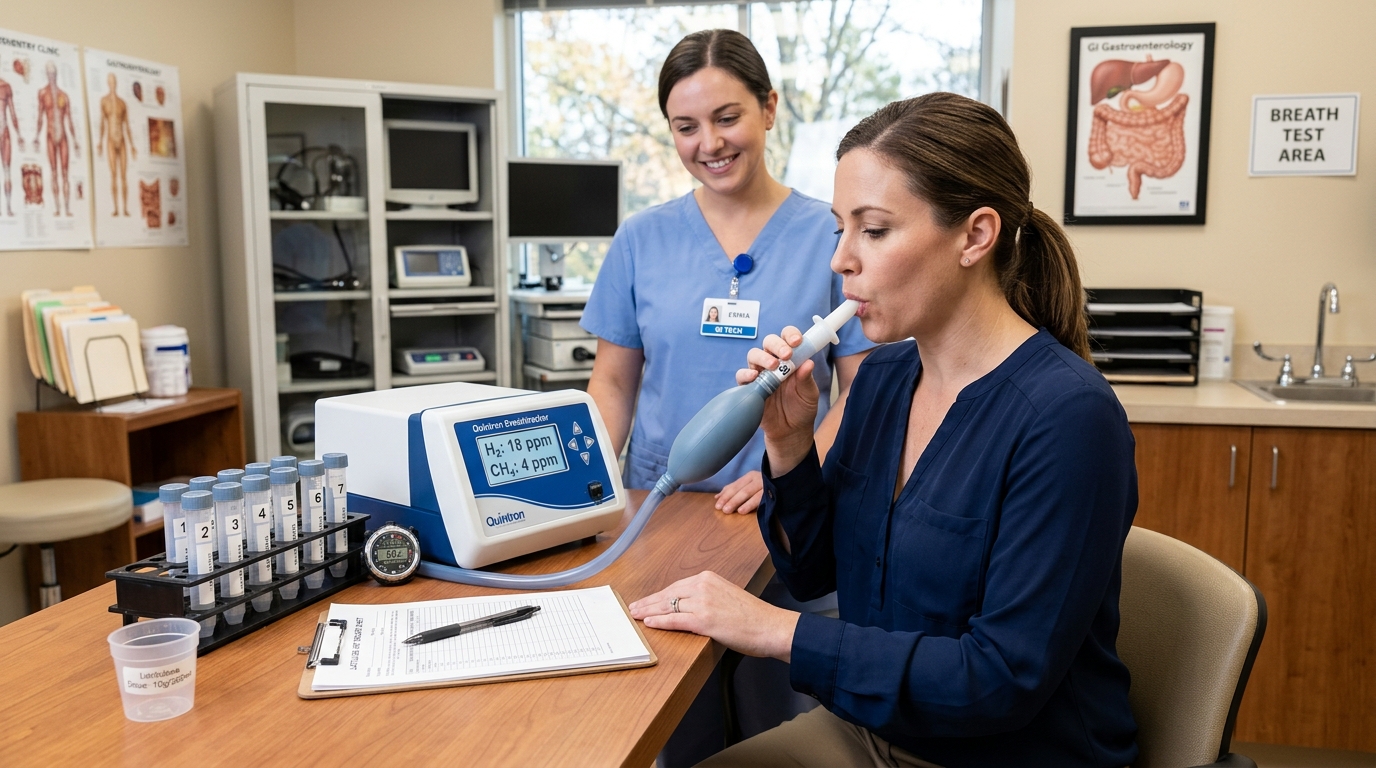
By administering a standardized oral carbohydrate substrate and analyzing serial end-expiratory alveolar breath samples over a 90-to-120-minute window, clinicians can reconstruct the spatial density and metabolic activity of the small intestinal microbiome non-invasively.
2. Substrate Kinetics: Lactulose vs. Glucose
The choice of test substrate represents the single most controversial debate in functional gastroenterology. Each agent possesses distinct biochemical properties that directly shape test sensitivity and specificity:
| Diagnostic Parameter | Glucose Breath Test (GBT) | Lactulose Breath Test (LBT) |
|---|---|---|
| Biochemical Identity | Naturally occurring monosaccharide | Synthetic disaccharide (galactose-fructose) |
| Standard Consensus Dose | 75 grams dissolved in water | 10 grams dissolved in water |
| Intestinal Absorption Site | Rapidly absorbed in proximal duodenum & jejunum | Non-absorbable; traverses entire 20-ft small bowel |
| Anatomical Reach | Proximal small intestine only (first 3–5 feet) | Duodenum, jejunum, ileum, and eventually colon |
| Clinical Sensitivity | Lower (~62%); completely misses distal ileal SIBO | Higher (~78%); captures distal bacterial colonization |
| Clinical Specificity | High (~88–92%); low rate of false positives | Lower (~65–70%); vulnerable to rapid transit false positives |
The Clinical Dilemma: Which Should You Use?
In the American College of Gastroenterology (ACG) Clinical Guideline for SIBO (Pimentel et al., Am J Gastroenterol 2020; PMID: 32023228), experts note that glucose is favored when maximal diagnostic specificity is required. If a patient produces a 20 ppm hydrogen surge 45 minutes after drinking glucose, there is near-absolute certainty that bacteria colonize the proximal jejunum, because glucose does not survive to reach the cecum.
Conversely, in clinical practice, many patients harbor bacterial overgrowth restricted primarily to the distal ileum, just proximal to an incompetent ileocecal valve. Because glucose is fully absorbed upstream, a glucose breath test in these patients yields a false-negative result. Lactulose solves this by reaching the distal ileum intact. However, if the patient has rapid orocecal transit time (OCTT)—common in diarrhea-predominant IBS—lactulose hits the cecum at 60 minutes. The explosive colonic fermentation that follows can be easily misread as severe SIBO.
3. The North American Consensus Criteria (Rezaie et al. 2017)
To standardize diagnostic interpretation, twenty leading motility experts published the North American Consensus on Breath Testing (Rezaie et al., Am J Gastroenterol 2017; PMID: 28323273). This document established the definitive diagnostic thresholds utilized today:
1. Hydrogen-Positive SIBO (Bacterial Overgrowth)
A rise in breath hydrogen of ≥ 20 ppm above baseline within 90 minutes following ingestion of either 10g lactulose or 75g glucose is considered diagnostic of SIBO. The 90-minute cutoff serves as a standardized proxy for the time it takes the substrate to enter the colon in average transit physiology.
2. Intestinal Methanogen Overgrowth (IMO)
A methane concentration of ≥ 10 ppm at any point during the test (including baseline breath sample 0) is diagnostic of IMO. Notice two crucial distinctions: IMO does not require a 20 ppm rise, nor is it restricted to the 90-minute window. Methane producers (archaea) can colonize the entire gastrointestinal tract, including the colon.
3. Hydrogen Sulfide (H&sub2;S) Overgrowth
Measured via specialized solid-state sensor platforms (such as the trio-smart breath analyzer), a peak hydrogen sulfide concentration of ≥ 3.0 ppm indicates sulfur-reducing bacterial overgrowth (e.g., Desulfovibrio piger). H&sub2;S gas acts as a potent smooth muscle relaxant and neurotoxin, strongly correlating with severe diarrhea, urgency, and visceral hyperalgesia.
4. Intestinal Methanogen Overgrowth (IMO): The Archaea Revolution
One of the most vital scientific updates in modern luminal gastroenterology is separating SIBO from IMO. Historically, elevated breath methane was lumped under the umbrella of "methane SIBO." However, microbiologists identified that the organisms synthesizing methane are not bacteria at all; they belong to the evolutionary domain Archaea, dominated by Methanobrevibacter smithii.
M. smithii is a hydrogen-consuming scavenger. For every molecule of methane it produces, it consumes four molecules of hydrogen:
This biochemical reaction creates two massive clinical ramifications:
- The Flatline Hydrogen Paradox: In heavy methanogen colonization, all hydrogen generated by bacteria is immediately scavenged by archaea to fuel methanogenesis. The patient's hydrogen curve appears completely flat (0–2 ppm throughout 120 minutes), which inexperienced clinicians misinterpret as "normal," ignoring a screaming methane level of 35 ppm.
- Profound Intestinal Hypomotility: Methane gas acts directly as a local neuromuscular paralyzing agent. Infusion of methane gas into animal ileum slows intestinal transit velocity by greater than 59%. Consequently, IMO clinically manifests as refractory constipation, severe dry stool fragmentation, and painful gaseous distension.
5. Mandatory Patient Preparation & Washout Protocols
The diagnostic validity of breath testing relies entirely upon meticulous pre-test preparation. Failure to comply with washout schedules produces uninterpretable baseline elevations or false-negative readings:
The Official Pre-Test Washout Schedule:
- Discontinue all systemic and oral antibiotics (rifaximin, ciprofloxacin, etc.).
- Postpone testing if the patient has undergone a colonoscopy, barium enema, or cathartic bowel lavage.
- Discontinue commercial probiotic supplements and fermented foods.
- Hold prokinetic motility agents (prucalopride, low-dose naltrexone, erythromycin).
- Discontinue osmotic and stimulant laxatives (magnesium citrate, MiraLAX, senna).
- Taper or pause PPIs and H2 blockers if clinically feasible.
- Strict low-fermentation diet: Baked skinless chicken or turkey breast, plain white jasmine rice, hard-boiled eggs, and tap water only.
- Zero fruits, vegetables, beans, dairy, spices, oils, or carbonated water.
Morning of Test: Minimum 12-hour overnight fast. No smoking, no gum chewing, no vigorous physical exercise (hyperventilation alters breath gas tension), and brush teeth with water only to minimize oral bacteria fermentation.
6. Peer-Reviewed Clinical Citations (PubMed References)
1. Rezaie A, Buresi M, Lembo A, et al. Hydrogen and Methane-Based Breath Testing in Gastrointestinal Disorders: The North American Consensus. Am J Gastroenterol. 2017;112(5):775-784. PMID: 28323273
2. Pimentel M, Saad RJ, Long MD, Rao SSC. ACG Clinical Guideline: Small Intestinal Bacterial Overgrowth. Am J Gastroenterol. 2020;115(2):165-178. PMID: 32023228
3. Takakura W, Pimentel M. Small Intestinal Bacterial Overgrowth and Irritable Bowel Syndrome - An Update. Front Psychiatry. 2020;11:664. PMID: 32754068
4. Rao SSC, Bhagatwala J. Small Intestinal Bacterial Overgrowth: Clinical Features and Therapeutic Management. Clin Transl Gastroenterol. 2019;10(10):e00078. PMID: 31584459
Frequently Asked Questions: Breath Testing Diagnostics
Which breath test substrate is superior: lactulose or glucose?
Neither substrate is universally superior; they possess reciprocal diagnostic trade-offs. Glucose is rapidly absorbed within the proximal 3 feet of the duodenum and jejunum; a positive test is almost 100% specific for proximal SIBO, but it fails to reach the distal ileum, missing distal overgrowth. Lactulose is non-absorbable and travels through the entire length of the small intestine to test distal ileal flora, but if a patient has rapid transit, lactulose reaches the colon prematurely, producing false-positive hydrogen spikes within 90 minutes.
What is Intestinal Methanogen Overgrowth (IMO) and how is it diagnosed differently from SIBO?
IMO is an overgrowth of archaea—predominantly Methanobrevibacter smithii—rather than bacteria. Methanogens utilize hydrogen gas produced by bacteria to generate methane (CH4). Under North American Consensus criteria, IMO is diagnosed when breath methane measures 10 ppm or greater at any point during the test, including baseline. Unlike hydrogen SIBO, IMO does not require a 20 ppm rise within 90 minutes because methanogens can colonize both the small intestine and colon, clinically manifesting as chronic constipation, delayed transit, and bloating.
Why is the 24-hour preparatory diet strictly required before a breath test?
Humans lack the biochemical enzymes to produce hydrogen or methane gas; all detectable breath hydrogen and methane originate exclusively from microbial fermentation of undigested carbohydrates. Ingesting complex plant fibers, legumes, fruits, or dairy on the day prior to testing results in lingering carbohydrate residues inside the lumen, producing high baseline gas levels (greater than 10 to 15 ppm) that completely invalidate the test.