1. The Epidemiological Shift: Colorectal Neoplasia in Adults Under 50
For decades, clinical gastroenterology classified colorectal adenocarcinoma primarily as a degenerative malignancy of later adulthood. Screening guidelines uniformly established age 50 as the universal benchmark for initiating routine endoscopic surveillance in average-risk individuals. That clinical paradigm has been shattered by unequivocal epidemiological surveillance.
While overall colorectal cancer rates in older populations have steadily declined—largely driven by high screening colonoscopy adherence that identifies and resects precancerous polyps—early-onset colorectal cancer (EOCRC), defined as malignancy diagnosed in patients under 50 years of age, has exhibited a dramatic and paradoxical escalation. According to National Cancer Institute SEER data and comprehensive epidemiological reviews published in The Lancet Gastroenterology & Hepatology, colorectal cancer incidence among individuals aged 20 to 49 has increased at an estimated rate of 1% to 2% annually since the mid-1990s.
Patients born around 1990 now demonstrate approximately twice the risk of colon cancer and four times the risk of rectal cancer compared to individuals born in 1950 at the same biological age. This pronounced birth cohort effect implicates complex interplay among early-life environmental exposures, westernized dietary patterns dense in ultra-processed foods and liquid fructose, antibiotic-induced dysbiosis of the colonic mucosal microbiome, and escalating rates of metabolic dysfunction. EOCRC is no longer a statistical outlier; it is the leading cause of cancer mortality in men under 50 and the second leading cause in young women.
2. Celebrity Advocacy & The "Lead From Behind" Cultural Impact
Public health messaging rarely achieves the reach or visceral emotional resonance generated by high-profile cultural milestones. In August 2020, the untimely death of actor Chadwick Boseman at age 43 from stage IV colon cancer—diagnosed initially at age 39—profoundly disrupted the broader public consciousness. His diagnosis underscored the sobering clinical reality that advanced colorectal malignancy can strike young, physically vigorous, highly active individuals with no prior family history of cancer.
Building upon this imperative, actor and entrepreneur Ryan Reynolds partnered with fellow actor Rob McElhenney and the national public health campaign Lead From Behind in 2022 to broadcast his routine screening colonoscopy upon reaching his 45th birthday. During that televised baseline examination, Reynolds's gastroenterologist identified and endoscopically resected an asymptomatic, subtile adenomatous polyp in his proximal colon—a precancerous lesion that, if left undetected over the subsequent decade, carried substantial potential for malignant transformation.
Public health studies investigating the "celebrity colonoscopy effect" demonstrate measurable surges in screening scheduling and digital search volume for gastrointestinal symptoms following high-profile advocacy. Yet, as gastroenterologists, we emphasize that celebrity awareness campaigns must bridge the gap from passive cultural fascination to concrete, disciplined preventive action. Public awareness matters most when it leads patients to seek timely clinical evaluation for early, subtle gastrointestinal symptoms rather than delaying care until advanced metastatic symptoms appear.
3. The Diagnostic Delay Trap: Red Flags vs Benign Assumptions
One of the most concerning clinical characteristics of early-onset colorectal cancer is the substantial diagnostic delay experienced by young patients. Multiple multi-center studies, including systematic reviews and meta-analyses published in Gastroenterology and JAMA Network Open (such as Kolb et al. and Demb et al.), demonstrate that patients under 50 endure an average diagnostic interval of 4 to 6 months between initial symptom onset and definitive endoscopic tissue biopsy.
This diagnostic lag stems from a dual cognitive trap: patient hesitation and physician misattribution. When an otherwise healthy 32-year-old notices bright red rectal bleeding (hematochezia), both the individual and often their initial healthcare provider reflexively assume the symptom represents benign hemorrhoidal bleeding or an acute anal fissure. Consequently, patients undergo repeated cycles of topical hydrocortisone suppositories, stool softeners, or dietary adjustments while an endoluminal neoplasm continues its silent transmural invasion.
Key Clinical Red Flags in Patients Under 50
- 1. Hematochezia (Rectal Bleeding): Bleeding that is mixed within the stool or accompanied by altered bowel frequency should never be attributed solely to internal hemorrhoids without objective evaluation.
- 2. Unexplained Microcytic Anemia: Low serum ferritin or microcytic iron-deficiency anemia in young men or post-menopausal women, or disproportionate anemia in pre-menopausal women not explained by menorrhagia, warrants bidirectional endoscopy.
- 3. Persistent Alterations in Stool Caliber: A narrowing of stool diameter ("pencil-thin stools") or alternating constipation and diarrhea persisting beyond 2 to 3 weeks indicates progressive mechanical lumen compromise.
- 4. Localized Abdominal or Pelvic Discomfort: Persistent lower quadrant cramping, postprandial distension, or deep rectal fullness (tenesmus) reflecting local mass effect.
In our clinical evaluation, no rectal bleeding should ever be dismissed as "just hemorrhoids" if it is persistent, recurrent, associated with dark blood or clots, or accompanied by altered bowel habits. As outlined in our comprehensive colorectal cancer screening guide, direct endoscopic visualization remains the gold standard for differentiating benign perianal lesions from proximal neoplastic pathology.
4. Adenoma Detection & Histopathology: Polyps to Carcinoma
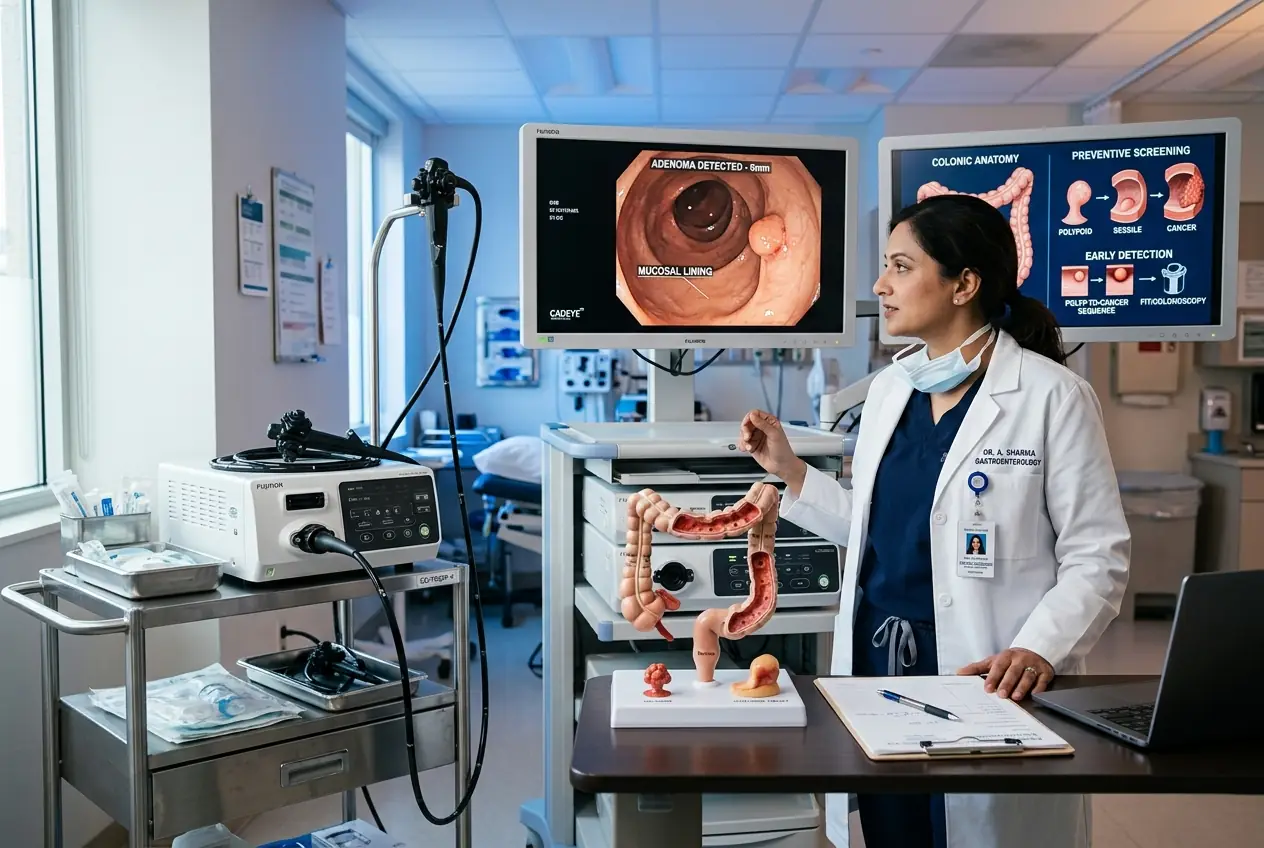
Understanding colorectal cancer prevention requires appreciating the underlying cellular biology of mucosal neoplasia. Invasive colorectal adenocarcinomas do not arise overnight from normal colon epithelium. Rather, more than 90% of colorectal malignancies originate from benign precursor lesions over an indolent, multi-year developmental timeframe termed the adenoma-to-carcinoma sequence.
The classic pathway, initially elucidated by Fearon and Vogelstein, involves sequential somatic genetic alterations: loss of the adenomatous polyposis coli (APC) tumor suppressor gene, followed by KRAS proto-oncogene activation, loss of 18q chromosomal heterozygosity, and final inactivation of TP53. This pathway produces pedunculated or sessile tubular, tubulovillous, and villous adenomas. Simultaneously, approximately 20% to 30% of colorectal cancers arise via the alternative serrated pathway, driven by BRAF V600E mutations and CpG island methylator phenotype (CIMP), yielding sessile serrated lesions (SSLs) that typically colonize the right colon and appear as subtle, mucus-capped mucosal folds easily obscured by suboptimal bowel preparation.
| Lesion Classification | Primary Anatomic Site | Molecular Driver | Malignant Transformation Rate | Endoscopic Management |
|---|---|---|---|---|
| Tubular Adenoma (<10mm) | Universal (Distal Predominance) | APC / KRAS / Wnt Pathway | Low (1–3% over 10 yrs) | Cold Snare Polypectomy |
| Tubulovillous / Villous Adenoma | Rectosigmoid & Descending Colon | APC + p53 Inactivation | Moderate–High (15–35%) | Endoscopic Mucosal Resection (EMR) |
| Sessile Serrated Lesion (SSL) | Proximal / Cecum & Ascending | BRAF V600E / CIMP / MSI-H | Accelerated in Dysplasia | Careful Complete Cold Snare / EMR |
| Early Invasive Carcinoma | Rectum & Left Colon (Higher in EOCRC) | Microsatellite Instability or CIN | Invasive Malignancy | Endoscopic Submucosal Dissection / Oncologic Surgery |
For detailed cellular and architectural breakdowns of these mucosal anomalies, consult our clinical reference on colon polyp pathology and adenoma-to-carcinoma mechanics. Furthermore, high-quality mucosal inspection requires an impeccably clean bowel lumen; review our analysis of split-dose bowel preparation science to understand how prep quality directly impacts adenoma detection rates (ADR).
5. Actionable Screening Protocols: USPSTF Age 45 Guidelines & Beyond
In May 2021, the United States Preventive Services Task Force (USPSTF) formally issued updated national guidelines lowering the recommended age to initiate average-risk colorectal cancer screening from 50 to 45. This decision, subsequently mirrored by the American College of Gastroenterology (ACG) and the American Cancer Society (ACS), represents a major public health victory backed by sophisticated mathematical decision-modeling through the Cancer Intervention and Surveillance Modeling Network (CISNET).
The CISNET modeling demonstrated that initiating screening at age 45 yields an estimated 22 to 27 additional life-years gained per 1,000 screened individuals, preventing 2 to 3 additional colorectal cancer deaths per 1,000 persons compared to deferring until age 50. The recommendation applies universally to all average-risk asymptomatic adults.
High-Risk Stratification: When Age 45 Is Not Soon Enough
It is critical to distinguish average-risk population screening from high-risk diagnostic surveillance. Individuals meeting any of the following criteria require earlier, tailored gastroenterological evaluation:
- • First-Degree Family History: Anyone with a parent, sibling, or child diagnosed with colorectal cancer or advanced adenomatous polyps before age 60 must start screening at age 40, or 10 years younger than the relative's age at diagnosis, whichever arrives first.
- • Hereditary Cancer Syndromes: Patients with proven or suspected Lynch syndrome (DNA mismatch repair deficiency involving MLH1, MSH2, MSH6, or PMS2) must begin high-resolution colonoscopic surveillance every 1 to 2 years starting between ages 20 and 25.
- • Inflammatory Bowel Disease (IBD): Chronic extensive ulcerative colitis or Crohn's colitis requires specialized chromoendoscopy surveillance beginning 8 years post-symptom onset to identify flat dysplastic mucosa.
In an era where viral social media trends champion unproven remedies—as we deconstruct in our exposé on debunking celebrity detox cleanses and colon hydrotherapy fads—the evidence-based gold standard for colorectal longevity remains clear, reproducible, and life-saving: timely endoscopic screening, vigilance regarding warning symptoms, and structured surveillance.
6. Frequently Asked Questions (Clinical FAQ)
Why did national medical guidelines lower the baseline colorectal cancer screening age to 45?
The United States Preventive Services Task Force (USPSTF) and American College of Gastroenterology (ACG) lowered the recommended average-risk screening age from 50 to 45 due to an alarming epidemiological shift. Over the past three decades, colorectal cancer incidence in individuals aged 40 to 49 increased by nearly 50%, with younger birth cohorts exhibiting substantially higher cumulative lifetime risk. Epidemiological modeling demonstrated that initiating screening at age 45 yields meaningful reductions in cancer mortality and prevents thousands of advanced-stage malignancies.
What are the most common early warning signs of colorectal cancer in adults under 50?
The primary clinical red flags for early-onset colorectal cancer include visible rectal bleeding (hematochezia), persistent alterations in bowel frequency or stool caliber (such as pencil-thin stools), unexplained microcytic iron-deficiency anemia, localized abdominal cramping or pelvic discomfort, and involuntary weight loss. In a JAMA Network Open meta-analysis of over 24 million patients, hematochezia and abdominal pain were the most predictive symptoms, frequently preceding diagnosis by several months.
Why is rectal bleeding in young adults so frequently dismissed or misdiagnosed?
Young adults and clinicians alike frequently attribute bright red rectal bleeding to benign anorectal conditions such as internal hemorrhoids or anal fissures. Because colorectal neoplasia was historically viewed as a disease exclusive to older adults, young patients often delay seeking evaluation for an average of 4 to 6 months, and healthcare providers may defer definitive endoscopic evaluation. Any persistent, recurrent, or unexplained rectal bleeding requires objective gastroenterological assessment regardless of age.
Who should undergo colorectal cancer screening prior to age 45?
Individuals with a first-degree relative (parent, sibling, or child) diagnosed with colorectal cancer or advanced adenomas should initiate screening at age 40, or 10 years earlier than the youngest affected relative's age at diagnosis, whichever is earlier. Furthermore, individuals with hereditary cancer syndromes such as Lynch syndrome (hereditary non-polyposis colorectal cancer) or Familial Adenomatous Polyposis (FAP), as well as patients with long-standing inflammatory bowel disease (ulcerative colitis or Crohn's colitis), require specialized early surveillance beginning in young adulthood.
How does colonoscopy prevent cancer rather than just detecting it?
Unlike purely diagnostic screening modalities (such as mammography or stool-based DNA tests), colonoscopy is both a diagnostic and an interventional preventative procedure. Over 90% of colorectal carcinomas arise from benign precancerous polyps—specifically tubular/villous adenomas and sessile serrated lesions—over a 7-to-15 year progression known as the adenoma-to-carcinoma sequence. By identifying and performing endoscopic mucosal resection (polypectomy) of these precursor lesions during colonoscopy, gastroenterologists halt the malignant cascade before cancer develops.
7. Peer-Reviewed Clinical Literature & Practice Guidelines
- Shaukat A, Kahi CJ, Burke CA, Rabeneck L, Sauer BG, Rex DK. ACG Clinical Guidelines: Colorectal Cancer Screening 2021. Am J Gastroenterol. 2021;116(3):458-479. PMID: 33657038
- Patel SG, Karlitz JJ, Yen T, Lieu CH, Boland CR. The rising tide of early-onset colorectal cancer: a comprehensive review of epidemiology, clinical features, biology, risk factors, prevention, and early detection. Lancet Gastroenterol Hepatol. 2022;7(3):262-274. PMID: 35090605
- Stoffel EM, Murphy CC. Epidemiology and Mechanisms of the Increasing Incidence of Colon and Rectal Cancers in Young Adults. Gastroenterology. 2020;158(2):341-353. PMID: 31394082
- Kolb JM, Patel SG, Shaukat A, et al. Early-Age Onset Colorectal Neoplasia in Average-Risk Individuals Undergoing Screening Colonoscopy: A Systematic Review and Meta-Analysis. Gastroenterology. 2021;161(4):1157-1168. PMID: 34119517
- Abualkhair WH, Zhou M, Jeon J, et al. Trends in Incidence of Early-Onset Colorectal Cancer in the United States Among Those Approaching Screening Age. JAMA Netw Open. 2020;3(1):e1920407. PMID: 32003823
- Demb J, Earles A, Martinez ME, et al. Red Flag Signs and Symptoms for Patients With Early-Onset Colorectal Cancer: A Systematic Review and Meta-Analysis. JAMA Netw Open. 2024;7(5):e2411630. PMID: 38787555