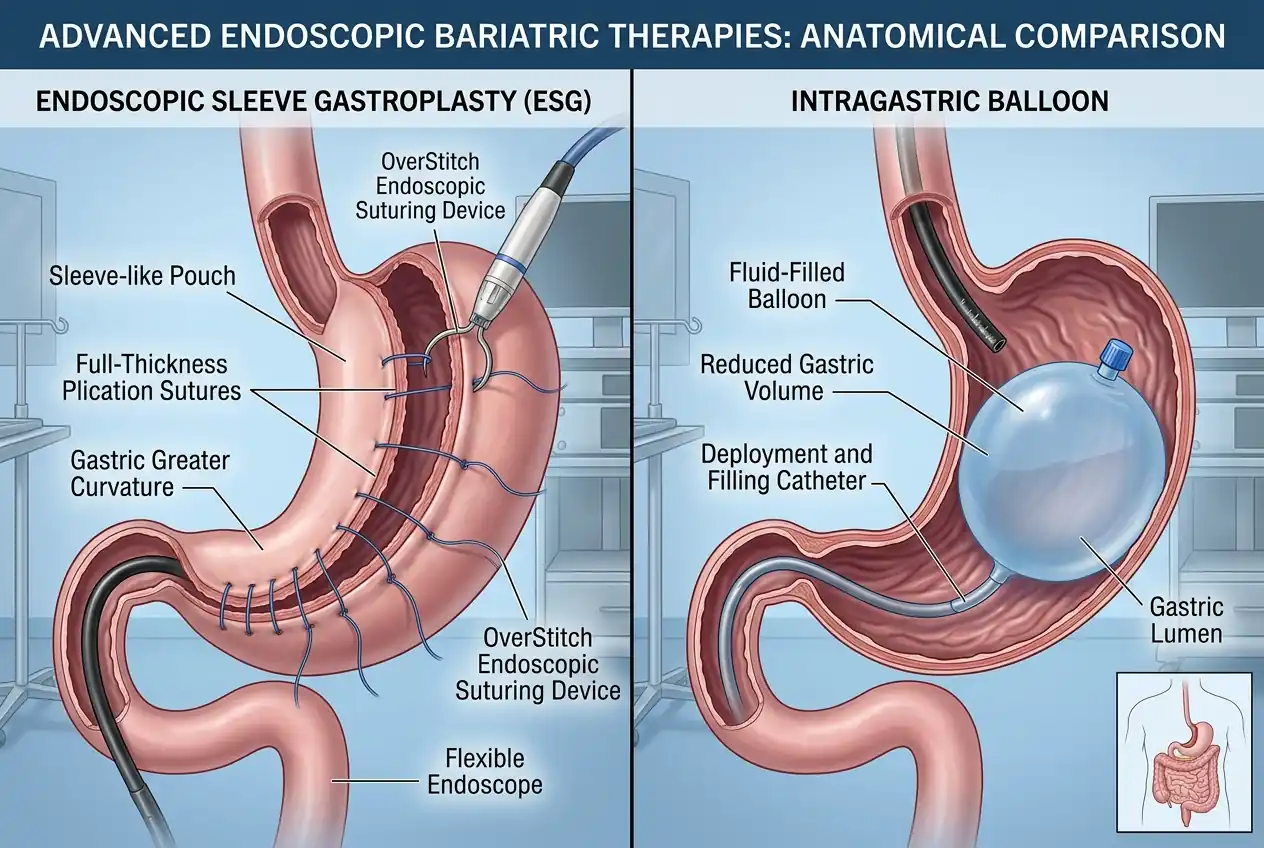
1. The Rise of Endoscopic Bariatric Therapies (EBMTs)
For decades, the therapeutic armamentarium for chronic adiposity suffered from an enormous clinical chasm. On one end stood lifestyle and behavioral modifications, which produce modest long-term total body weight loss (typically 3% to 5%) due to powerful neurohormonal counter-regulatory responses. On the opposing end stood bariatric metabolic surgery—specifically laparoscopic Roux-en-Y gastric bypass (RYGB) and laparoscopic sleeve gastrectomy (LSG)—which deliver profound, durable weight loss (25% to 30% TBWL) and metabolic remission, yet are utilized by fewer than 1% to 2% of eligible candidates worldwide due to invasiveness, permanent anatomical alterations, fear of complications, or lack of access.
Enter Endoscopic Bariatric and Metabolic Therapies (EBMTs). Spurred by exponential advances in flexible therapeutic endoscopes, endoluminal suture anchors, and specialized biomaterials, gastroenterologists have pioneered procedures that alter gastric capacity and delay neuroendocrine emptying entirely through the natural orifice of the mouth.
However, the rapid migration of EBMTs into celebrity culture and medical spa marketing has generated unrealistic expectations. Commercial advertisements frequently promote 'swallowable gastric balloons' and 'non-surgical stomach stitching' as pain-free, effortless weekend transformations with guaranteed permanent results. As practicing gastroenterologists who manage post-procedural complications and complex motility disorders, we must separate empirical clinical literature from viral marketing narratives.
2. Endoscopic Sleeve Gastroplasty (ESG): The Apollo OverStitch Science
Endoscopic Sleeve Gastroplasty (ESG) is the premier primary endoluminal restrictive procedure performed in gastroenterology today. Performed under endotracheal general anesthesia, ESG utilizes an endoscopic suturing system—most notably the FDA-cleared Apollo OverStitch device—mounted onto a double-channel therapeutic gastroscope.
Rather than resecting tissue, the operator places a series of 4 to 8 full-thickness, non-absorbable polypropylene sutures along the anterior wall, greater curvature, and posterior wall of the gastric body. When cinched, these sutures create longitudinal plications that accordion and invert the stomach wall, transforming a capacious 1,200 mL reservoir into a narrow, tubular conduit with roughly 70% to 80% volume reduction. Importantly, the gastric fundus is intentionally spared to preserve accommodation reflexes, and the native mesenteric blood supply and vagal nerve trunks remain completely intact.
The definitive clinical benchmark for ESG was established by the multicenter randomized MERIT trial (Abu Dayyeh et al., published in The Lancet in 2022). In this prospective trial across nine U.S. centers involving Class 1 and Class 2 obesity (BMI 30–40 kg/m²), ESG combined with moderate lifestyle modification achieved a mean 13.6% total body weight loss (%TBWL) and 49.2% excess weight loss at 52 weeks, compared to just 0.8% TBWL in lifestyle-alone controls. At 104 weeks, 68% of patients maintained significant clinical weight reduction, and 80% experienced marked improvements in cardiometabolic parameters, including blood pressure, HbA1c, and hepatic steatosis.
For patients struggling with metabolic liver disease, significant weight reduction remains the cornerstone of hepatic histology improvement; review our detailed physician guide to reversing MASLD and fibrotic MASH to explore how visceral fat reduction halts hepatic lipotoxicity.
3. Intragastric Balloons: Fluid, Swallowable & Intolerance Rates
Intragastric Balloons (IGBs) represent the most publicized temporary bariatric devices. Conceptually simple, an IGB is a space-occupying spherical prosthesis deployed in the gastric lumen to occupy 400 to 700 mL of functional volume, thereby triggering mechanoreceptors that induce early satiety and physically limiting bolus meal capacity.
Two primary formats dominate modern clinical practice:
- Fluid-Filled Endoscopic Balloons (e.g., Orbera): Placed endoscopically under conscious sedation, filled with 450 to 650 mL of sterile saline tinted with methylene blue (an indicator dye that turns the patient's urine greenish-blue in the rare event of balloon rupture), and endoscopically removed after 6 months.
- Swallowable Gas/Fluid Balloons (e.g., Allurion/Elipse): Ingested as a capsule attached to an external micro-catheter under fluoroscopic guidance, inflated with fluid in the stomach, and engineered with a timed bio-degradable release valve that opens at approximately 16 weeks, allowing the deflated membrane to pass spontaneously through the gastrointestinal tract.
While clinical trials report average weight loss between 10% and 14% TBWL while the balloon resides in the stomach, the real-world gastroenterological reality includes substantial device intolerance. During the first 72 to 96 hours post-placement, the stomach vigorously attempts to grind and expel the foreign body, causing intense nausea, intractable projectile vomiting, and violent epigastric spasms.
According to FDA premarket approval registry data and multicenter peer-reviewed clinical registries (such as Genco et al. and Fayad et al.), 10% to 18% of patients require premature balloon extraction within the first few weeks due to unmanageable intolerance despite aggressive anti-emetic and antispasmodic therapy. Furthermore, once the balloon is removed, the physical restriction disappears; without intense ongoing metabolic therapy, weight regain is ubiquitous.
4. Clinical Matrix: ESG vs Intragastric Balloons vs GLP-1s vs Surgery
To assist patients and clinicians navigating these therapeutic choices, the table below provides a rigorous clinical comparison based on published pivotal trials, procedural invasiveness, and durability:
| Therapeutic Modality | Average %TBWL (1 Year) | Invasiveness & Anesthesia | Durability / Reversibility | Primary Clinical Limitation |
|---|---|---|---|---|
| Intragastric Balloon (IGB) | 10% – 14% TBWL | Endoscopic / Swallowable (Minimal) | Strictly Temporary (4–6 Mo) | High intolerance rate; substantial post-removal regain |
| Endoscopic Sleeve Gastroplasty (ESG) | 13% – 18% TBWL | Endoscopic Suturing (General Anesthesia) | Multi-Year Durability; Organ-Preserving | Procedural skill curve; out-of-pocket commercial cost |
| Semaglutide 2.4 mg (GLP-1 RA) | ~15% TBWL | Non-invasive (Weekly SC Injection) | Requires Chronic Indefinite Use | GI dysmotility; rapid 2/3 weight rebound on cessation |
| Tirzepatide 15 mg (GIP/GLP-1) | ~21% TBWL | Non-invasive (Weekly SC Injection) | Requires Chronic Indefinite Use | GI intolerance; indefinite continuation required |
| Surgical Sleeve Gastrectomy (LSG) | 25% – 30% TBWL | Laparoscopic Surgery (General Anesthesia) | Permanent / Irreversible Gastric Resection | Surgical risks; permanent de novo GERD exacerbation |
For an extensive analysis of incretin pharmacology, gastric clearance delays, and post-cessation metabolic rebounds, review our feature on the Hollywood GLP-1 phenomenon and gastric kinetics.
5. Procedural Safety, Reflux Dynamics & Weight Regain Biology
While endoscopic bariatric therapies circumvent surgical incisions, they are formal gastroenterological procedures requiring meticulous risk stratification. Key safety considerations include:
Critical Clinical Safety & Risk Profiles
- Gastroesophageal Reflux Disease (GERD) Dynamics: Surgical sleeve gastrectomy (LSG) is notorious for inducing or worsening severe reflux due to elevated intraluminal pressure and blunting of the angle of His. In contrast, ESG typically preserves lower esophageal sphincter mechanics, showing negligible de novo GERD rates in the MERIT trial. However, intragastric balloons frequently aggravate preexisting reflux by physically displacing acid into the distal esophagus. Review our clinical guidelines on persistent GERD and Barrett's esophagus warning signs.
- Ulceration & Mechanical Perforation: Prolonged mucosal pressure from intragastric balloons can induce ischemic mucosal ulcerations. In severe, rare cases, full-thickness gastric wall necrosis or perforation occurs. Prior gastric surgery (e.g., Nissen fundoplication) or active peptic ulcer disease represents an absolute contraindication to balloon placement.
- Balloon Migration & Intestinal Obstruction: If an intragastric balloon deflates prematurely without detection, it can migrate through the pylorus into the small intestine, lodging at the ileocecal valve and precipitating acute mechanical bowel obstruction requiring laparotomy.
- Anesthesia Standards in Therapeutic Endoscopy: ESG requires skilled endoluminal knot-tying and full-thickness mucosal opposition lasting 60 to 90 minutes. Review our endoscopic safety and sedation standards to understand monitored anesthesia care (MAC) and endotracheal protection.
Ultimately, neither a suture nor a silicone balloon cures the underlying neuro-metabolic pathophysiology of chronic adiposity. Endoscopic procedures are exceptional metabolic catalytic tools—but their long-term efficacy is completely contingent upon permanent dietary reconstitution, structured resistance training to preserve lean skeletal muscle, and comprehensive medical follow-up.
6. Frequently Asked Questions (Clinical FAQ)
What is Endoscopic Sleeve Gastroplasty (ESG) and how does it differ from surgical sleeve gastrectomy?
Endoscopic Sleeve Gastroplasty (ESG) is an incisionless, organ-sparing procedure performed entirely through a flexible endoscope advanced via the esophagus under general anesthesia. Using a specialized endoscopic suturing system (Apollo OverStitch), the gastroenterologist places full-thickness triangular or running plication sutures along the gastric greater curvature, reducing gastric volume by roughly 70% to 80% into a restrictive sleeve-like tube. Unlike surgical laparoscopic sleeve gastrectomy (LSG), ESG does not surgically excise, transect, or permanently remove any gastric tissue, preserving native vascularity, innervation, and anatomy.
How much weight loss can a patient expect from Endoscopic Sleeve Gastroplasty?
In the landmark multicenter randomized MERIT trial (Abu Dayyeh et al., The Lancet 2022), patients undergoing ESG achieved a mean total body weight loss (%TBWL) of 13.6% (and 49.2% excess weight loss) at 52 weeks, compared to just 0.8% with lifestyle intervention alone. At 104 weeks, 68% of patients maintained clinical weight loss success. Long-term registries indicate average weight reduction between 15% and 18% TBWL at 1 to 2 years when paired with structured nutritional and behavioral support.
Why is weight regain so common following the removal of intragastric balloons?
Intragastric balloons (IGBs) are strictly temporary mechanical devices designed to occupy 400 to 700 mL of space within the gastric lumen for 4 to 6 months before endoscopic removal or natural excretion. Once the device is extracted, the physical restriction and delayed gastric emptying vanish immediately. Without ongoing metabolic alteration or continued pharmacological/behavioral obesity therapy, neurohormonal signals (such as elevated ghrelin and reduced GLP-1/PYY) trigger compensatory hunger, leading many patients to regain a significant portion of lost weight within 12 months.
How do endoscopic bariatric procedures compare to GLP-1 and dual GIP/GLP-1 medications?
Pivotal clinical trials demonstrate that injectable incretin mimetics (such as semaglutide 2.4 mg and tirzepatide 15 mg) yield average weight loss of approximately 15% and 21% TBWL, respectively, which equals or exceeds ESG. However, medications require continuous, indefinite weekly injections; cessation triggers rapid metabolic rebound and weight regain in over two-thirds of patients. ESG provides a one-time anatomical restriction that maintains durability over multiple years without reliance on chronic drug tolerance or prescription supply chains.
What are the primary clinical risks and complications associated with intragastric balloons?
Early adverse effects include acute device intolerance characterized by intense nausea, intractable vomiting, and epigastric cramping, resulting in early removal in 10% to 18% of patients according to FDA premarket approval registries. Serious documented gastroenterological risks include gastric mucosal ulceration, acute pancreatitis from balloon compression against the pancreatic bed, gastric perforation, spontaneous balloon hyperinflation, and balloon deflation leading to distal migration and mechanical small bowel obstruction requiring emergency surgical extraction.
7. Peer-Reviewed Clinical Literature & Practice Guidelines
- Abu Dayyeh BK, Bazerbachi F, Vargas EJ, et al. Endoscopic sleeve gastroplasty for treatment of class 1 and 2 obesity (MERIT): a prospective, multicentre, randomised trial. The Lancet. 2022;400(10350):441-451. PMID: 35908555
- Fayad L, Cheskin LJ, Adam A, et al. Endoscopic sleeve gastroplasty versus intragastric balloon insertion: efficacy, durability, and safety. Endoscopy. 2019;51(6):532-539. PMID: 30841009
- Sharaiha RZ, Kumta NA, Saumoy M, et al. Endoscopic Sleeve Gastroplasty for Obesity: a Multicenter Study of 248 Patients with 24 Months Follow-Up. Obes Surg. 2017;27(10):2649-2655. PMID: 28451929
- Genco A, Soricelli E, Casella G, et al. Intragastric balloon treatment of obesity: Long-term results and patient satisfaction. Turk J Gastroenterol. 2019;30(6):506-512. PMID: 31061001
- Wilding JPH, Batterham RL, Calanna S, et al. Once-weekly semaglutide in adults with overweight or obesity (STEP-1). N Engl J Med. 2021;384:989-1002. PMID: 33567185
- Jastreboff AM, Aronne LJ, Ahmad NN, et al. Tirzepatide once weekly for the treatment of obesity (SURMOUNT-1). N Engl J Med. 2022;387(3):205-216. PMID: 35658024