Bile Acid Malabsorption (BAM): The Hidden Driver of Unexplained Chronic Diarrhea & IBS-D Misdiagnosis
A gastroenterology analysis of enterohepatic circulation failure. How defective ileal ASBT transport and FGF-19 negative feedback deficiency cause secretomotor colonic diarrhea, why up to 35% of IBS-D patients are misdiagnosed, and the clinical power of empiric bile acid binder trials.
Key Diagnostic Takeaways
- The IBS-D Masquerade: Approximately 25% to 35% of patients carrying a functional diagnosis of diarrhea-predominant irritable bowel syndrome (IBS-D) actually suffer from organic, treatable Bile Acid Diarrhea (BAD).
- Secretory-Motor Mechanism: Excess unabsorbed dihydroxy bile acids entering the cecum hyper-stimulate epithelial CFTR chloride channels, flooding the colon with water while provoking high-amplitude propagating motor contractions (HAPCs) that cause severe fecal urgency.
- The FGF-19 Deficit: In idiopathic (Type 2) BAM, enterocytes fail to secrete Fibroblast Growth Factor 19 (FGF-19). Lacking this critical brake, hepatic CYP7A1 runs uninhibited, flooding the digestive tract with massive excess bile acid pools.
- Therapeutic Confirmation: In the United States—where 75SeHCAT nuclear retention scanning is unavailable—a 10-to-14-day empirical therapeutic trial with a bile acid sequestrant (such as colesevelam or cholestyramine) provides rapid diagnostic confirmation and clinical relief.
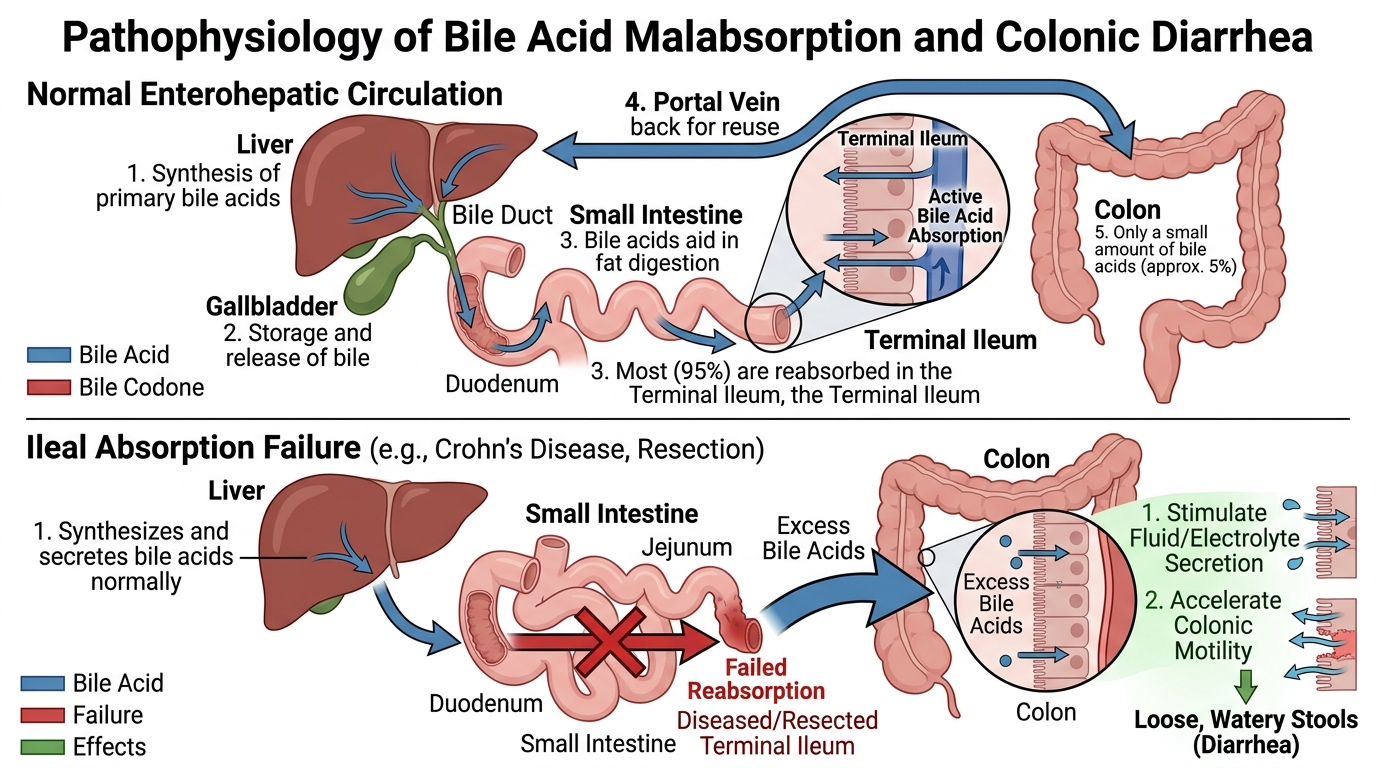
1. Enterohepatic Physiology: The Brilliant 95% Conservation Loop
To understand why bile acid malabsorption (BAM)—also known clinically as bile acid diarrhea (BAD)—is both so devastating and so frequently overlooked, one must first appreciate the extraordinary efficiency of the normal human enterohepatic circulation.
Every day, human hepatocytes synthesize approximately 0.5 grams of primary bile acids (cholic acid and chenodeoxycholic acid) de novo from cholesterol. The rate-limiting enzyme in this biosynthetic cascade is cholesterol 7α-hydroxylase (CYP7A1). Once synthesized, these bile acids are conjugated to glycine or taurine to increase their water solubility at physiological pH, secreted into biliary canaliculi, stored in the gallbladder, and discharged into the duodenum in response to postprandial cholecystokinin (CCK) release.
Inside the proximal small intestine, bile acids form mixed micelles with dietary lipids, fat-soluble vitamins (A, D, E, K), and cholesterol, enabling their enzymatic breakdown and mucosal uptake. However, bile acids are biologically expensive to manufacture. Consequently, evolution engineered a high-affinity recycling loop:
- The Ileal Transporter (ASBT): When the intestinal chyme reaches the distal 100 cm of the small intestine (the terminal ileum), specialized enterocytes express the Apical Sodium-Dependent Bile Acid Transporter (ASBT, encoded by SLC10A2). ASBT actively reabsorbs greater than 95% of all secreted bile acids against a steep concentration gradient.
- The FGF-19 Endocrine Brake: Intracellular bile acids bind to the nuclear Farnesoid X Receptor (FXR) inside ileal enterocytes. FXR activation triggers synthesis and basolateral secretion of Fibroblast Growth Factor 19 (FGF-19). FGF-19 travels via mesenteric portal blood directly to the liver, where it binds the FGFR4/β-Klotho receptor complex on hepatocytes, strongly downregulating CYP7A1 gene expression. This negative feedback loop halts further bile acid synthesis until the current pool is exhausted.
Under normal physiology, only a tiny fraction (roughly 5%, or 0.2 to 0.5 grams daily) escapes ileal absorption to enter the colon, where colonic anaerobic bacteria deconjugate and 7α-dehydroxylate them into secondary bile acids (deoxycholic acid and lithocholic acid) excreted in stool.
2. Classification: Types 1, 2, and 3 BAM
When this exquisite balance fails, excessive quantities of unabsorbed bile acids enter the large intestine. Clinical gastroenterology classifies BAM into three distinct pathophysiological phenotypes:
| BAM Classification | Primary Etiology | Molecular / Anatomical Mechanism | Clinical Presentation |
|---|---|---|---|
| Type 1: Ileal Dysfunction | Crohn's Disease, Ileal Resection, Radiation Ileitis | Physical destruction or surgical loss of terminal ileal mucosa; severe loss of ASBT surface area | Watery diarrhea beginning immediately following ileocecal resection (>100 cm resection causes steatorrhea) |
| Type 2: Primary / Idiopathic | Unexplained Chronic Diarrhea, "IBS-D" Overlap | Morphologically pristine ileum with FGF-19 endocrine deficiency; failure to suppress hepatic CYP7A1 | Severe postprandial urgency, nocturnal diarrhea, yellowish watery stools in otherwise healthy adults |
| Type 3: Miscellaneous Secondary | Post-Cholecystectomy, Celiac Disease, Chronic Pancreatitis, SIBO | Continuous non-pulsatile biliary dumping, mucosal enteropathy, or premature bacterial deconjugation | Diarrhea emerging months after gallbladder removal or in treated celiac patients with persistent loose stools |
The Breakthrough Discovery in Type 2 Idiopathic BAM
For decades, patients presenting with chronic secretory diarrhea and normal colonoscopies were labeled as "neurotic" or assigned an unhelpful diagnosis of IBS-D. In landmark research, Professor Julian R. Walters and colleagues at Imperial College London unlocked the true molecular pathology of Type 2 BAM (Walters et al., Clin Gastroenterol Hepatol 2009; PMID: 19426836).
They discovered that these patients do not have an anatomical absorption defect. Instead, their ileal enterocytes suffer from a genetic or epigenetic failure to synthesize FGF-19. Because portal FGF-19 levels remain abnormally low, the patient's liver never receives the signal that bile acid supplies are adequate. Hepatic CYP7A1 runs wide open 24 hours a day, synthesizing massive excess pools of bile acids that completely saturate normal ASBT capacity. The spillover cascades into the colon, causing unrelenting diarrhea.
3. The Secretomotor Cascade: How Bile Acids Provoke Diarrhea
When excess dihydroxy bile acids (chenodeoxycholic acid and deoxycholic acid) enter the cecum at concentrations exceeding 3 to 5 mmol/L, they act as potent mucosal toxins and secretagogues:
1. CFTR Chloride Channel Activation
Bile acids bind to TGR5 and apical receptors on colonocytes, activating intracellular cyclic AMP (cAMP) and calcium signaling cascades. This phosphorylates and locks open the Cystic Fibrosis Transmembrane Conductance Regulator (CFTR) chloride channel. Colonocytes dump massive quantities of chloride ions into the bowel lumen, followed osmotically by sodium and water.
2. High-Amplitude Propagating Contractions (HAPCs)
Intraluminal bile acids irritate colonic sensory neurons and smooth muscle receptors, stimulating high-amplitude propagating contractions. These sweeping motor waves rapidly propel liquid stool through the transverse and descending colon, causing the sudden, explosive postprandial urgency and fecal incontinence characteristic of BAD.
3. Mucosal Barrier Breakdown
Surfactant actions of concentrated deoxycholic acid disrupt epithelial tight-junction claudin proteins, increasing mucosal permeability. This allows bacterial endotoxins (LPS) to permeate the lamina propria, provoking localized immune activation and low-grade mucosal inflammation.
4. Mucus Hyper-Secretion
Colonic goblet cells discharge thick mucus blankets in an attempt to shield the mucosal epithelium from bile acid caustic injury, explaining the gelatinous, yellowish discharge frequently described by patients in clinical consultations.
4. The IBS-D Overlap: A Widespread Diagnostic Failure
Systematic reviews and meta-analyses led by Dr. Michael Camilleri at the Mayo Clinic (Camilleri, Gut Liver 2015; PMID: 25918262) have demonstrated that more than 25% to 35% of all patients meeting Rome IV diagnostic criteria for Diarrhea-Predominant Irritable Bowel Syndrome (IBS-D) actually have underlying Bile Acid Malabsorption.
Why is BAM missed so frequently?
- The Diagnostic Void in North America: In the United Kingdom and Europe, clinicians routinely diagnose BAM using the 75SeHCAT (75-Selenium Homocholic Acid Taurine) retention scan. A 7-day whole-body retention < 10% confirms moderate BAM, and < 5% confirms severe BAM. However, the United States FDA never approved the SeHCAT radiotracer, leaving American gastroenterologists without ready access to the global gold standard.
- Misleading "Normal" Bloodwork: Routine CBC, comprehensive metabolic panels, celiac serologies, and fecal calprotectin are completely normal in Type 2 BAM. Stool cultures for pathogens return negative.
- Normal Endoscopy: Optical colonoscopy with terminal ileal intubation and mucosal biopsy appears pristine, falsely reassuring clinicians that inflammatory bowel disease is absent.
5. Diagnostic Biomarkers & Empiric Sequestrant Trials
In the absence of SeHCAT testing in the United States, modern practice relies on advanced serum biomarkers, specialized stool testing, or empirical pharmacotherapy:
1. Fasting Serum C4 (7α-hydroxy-4-cholesten-3-one)
C4 is an intermediate metabolite produced during hepatic bile acid synthesis by CYP7A1. When enterohepatic recycling is disrupted, the liver accelerates synthesis, causing serum C4 to surge. A fasting morning serum C4 > 47.1 ng/mL exhibits high sensitivity and specificity for BAM.
2. Fasting Serum FGF-19 Quantification
A fasting serum FGF-19 < 145 pg/mL identifies patients suffering from defective ileal feedback inhibition. Combining an elevated C4 with a suppressed FGF-19 is virtually pathognomonic for Type 2 idiopathic bile acid diarrhea.
3. The 48-Hour Fecal Bile Acid Test (Mayo Reference Lab)
While demanding for the patient, collecting all stool over a 48-hour period while adhering to a 100g fat daily diet directly quantifies bile acid losses. A total fecal bile acid excretion > 2,337 μmol/48 hours or a primary bile acid fraction > 10% confirms severe colonic dumping.
4. The Empirical Therapeutic Sequestrant Trial
In everyday clinical practice, the most pragmatic diagnostic strategy is an empirical therapeutic trial of a Bile Acid Sequestrant (BAS) for 10 to 14 days. If a patient who has suffered from chronic watery diarrhea for five years experiences firm, formed stools within 72 hours of taking a bile acid binder, the diagnosis of BAM is clinically established.
6. Evidence-Based Therapeutic Protocols: Bile Acid Sequestrants
Bile acid sequestrants are non-absorbable anion-exchange polymers that carry positive charges. In the intestinal lumen, they electrostatically bind negatively charged bile acid molecules, forming stable, insoluble complexes that pass harmlessly through the colon into stool, depriving them of the ability to stimulate CFTR chloride channels:
- Cholestyramine (Questran): The classic powder formulation. Initiated at 4 grams (one packet) once daily mixed in water or juice, titrated up to 4g two to four times daily. While highly effective, adherence is limited by its gritty texture and unpalatable taste.
- Colestipol (Colestid): Available as 1-gram tablets or flavored granules, offering a more palatable alternative to cholestyramine powder.
- Colesevelam (Welchol): A modern, high-affinity polymer tablet (625 mg per tablet; typical dose 3 tablets twice daily with meals). Colesevelam has fewer gastrointestinal side effects, binds bile acids with greater avidity, and does not interfere as extensively with fat-soluble vitamin absorption (Vijayvargiya et al., Dig Dis Sci 2018; PMID: 32088296).
7. Peer-Reviewed Clinical Citations (PubMed References)
1. Walters JR, Johnston IM, Nolan JD, et al. The response of patients with bile acid diarrhoea to the farnesoid X receptor agonist obeticholic acid. Aliment Pharmacol Ther. 2015;41(1):54-64. PMID: 25329562
2. Camilleri M. Bile Acid diarrhea: prevalence, pathogenesis, and therapy. Gut Liver. 2015;9(3):332-339. PMID: 25918262
3. Vijayvargiya P, Camilleri M, Chedid V, et al. Effects of Colesevelam on Fecal Bile Acids and Bowel Functions in Diarrhea-Predominant Irritable Bowel Syndrome. Dig Dis Sci. 2018;63(12):3427-3436. PMID: 32088296
4. Walters JR. Defining primary bile acid diarrhea. Clin Gastroenterol Hepatol. 2010;8(11):921-923. PMID: 20932141
Frequently Asked Questions: Bile Acid Diarrhea
Why is bile acid malabsorption frequently misdiagnosed as IBS-D?
BAM produces chronic watery diarrhea, sudden postprandial fecal urgency, fecal incontinence, and crampy abdominal pain that mimic diarrhea-predominant irritable bowel syndrome (IBS-D). Clinical studies demonstrate that between 25% and 35% of all patients diagnosed with IBS-D actually suffer from unrecognized BAM. Because the European gold-standard 75SeHCAT retention test is unavailable in the United States, American clinicians frequently overlook the diagnosis unless they perform serum C4 testing, fecal bile acid assays, or an empirical trial of bile acid sequestrants.
How do unabsorbed bile acids cause severe diarrhea in the colon?
When excess dihydroxy bile acids (chenodeoxycholic acid and deoxycholic acid) spill into the colon, they act as potent mucosal secretagogues. They stimulate the cystic fibrosis transmembrane conductance regulator (CFTR) chloride channels on colonic epithelial cells, forcing massive active secretion of chloride, sodium, and water into the lumen. Concurrently, they stimulate high-amplitude propagating contractions (HAPCs) in colonic smooth muscle, generating intense cramping and sudden motor evacuation.
What medications are used to treat bile acid diarrhea?
First-line therapy consists of oral bile acid sequestrants (resins) that electrostatically bind negatively charged bile acids within the small intestinal lumen, forming insoluble, non-absorbable complexes that prevent them from stimulating colonic secretion. These include cholestyramine powder, colestipol tablets, and colesevelam (Welchol) tablets. Rapid resolution of chronic diarrhea within 3 to 5 days of starting a sequestrant confirms the clinical diagnosis.